
Whisky in Space: the Road Show – Update
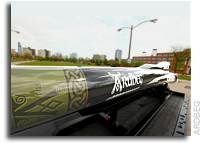
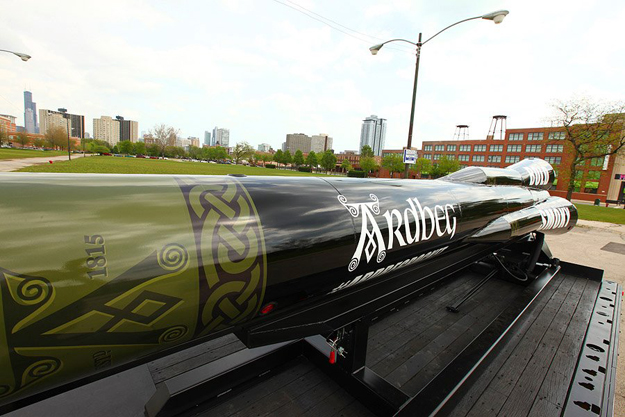
 Keith’s note: Ardbeg Distillery recently announced its “U.S. Ardbeg Rocket Tour” – which apparently has a rocket prop as part of the overall PR effort. [Larger image via Facebook]. Ardbeg has a commercial experiment that is currently operating aboard the International Space Station via Nanoracks. While this company seems to be extremely excited and willing to use space research as part of their overall advertising campaign, NASA doesn’t seem to be remotely interested in talking about it – despite all the agency’s hype about wanting to encourage commercial research on the ISS. Go figure.
– Whisky in Space – the Road Show, earlier post
– An Actual ISS Commercial Experiment that NASA/CASIS Ignores, earlier post



It would be nice if this could be described as one of many commercial ISS payloads. For it to be about the only one is a trifle embarrassing. Although I would not put down a good drink, I have some doubt they will be able to afford to produce commercial quantities there.
Not sure why you say it would be embarrassing – because it’s the only one or because it’s about an alcohol product?
If it led to improved food, ag, cosmetics, fertilizers, natural pesticides, solvents, soaps, coatings, and more, would it be viewed differently?
Some of the processes they are looking into have broad applicability outside of the production of liquor. You’d think the spinoff hype folks at NASA would be talking about that. Fermentation is an important industrial process on Earth and I cannot help but imagine that something will be learned from this research that someone in another industrial sector will find to be useful.
Let’s not confuse “research” here with something peer reviewed. There is (proudly, it seems) no peer review for a Nanorack experiment. This is where you just buy a slot. It doesn’t have to be any kind of credible “experiment”. While the Ardbeg “research” seems to be about terpenes interacting with charcoal, I could well guess that it’s more about the creation of media fodder than information, for $50K. Not a crazy idea.
Why, a presidential campaign could spend $50K to, er, research the effects of microgravity on a campaign button. Why, with supplied power, it could be one with a blinking light on it! The press would eat it up.
I can’t imagine why NASA isn’t remotely interested in talking about this research. Hmmm.
Who said anything about peer-review? I am certain that the company reviewed the idea internally before they decided to spend THEIR money on this. This is commercially-sponsored/paid for research. Do you know what the word “commercial” means? 98% of your posts here on NASA Watch are negative – regardless of the topic. Suggest you take a break and go cheer yourself up.
I was the one who brought up peer review. In scientific research, peer review is what distinguishes quality of task. For product research, independent peer review is obviously unnecessary, but we have no way to assess the quality of the task. We have to assume that Ardberg has established that for themselves.
Actually, I was being quite positive, in that at the least, Ardberg has made commercial use of Nanoracks to advertise itself. That’s a very creative use of that commercial opportunity. Maybe there is more to it than that, but unless we know more about why Ardberg is doing this, it’s kinda hard to say.
The negativity here was the incredulity about why NASA wasn’t paying more attention to it. That’s a fair question. But it may be that NASA is just reluctant to appear to be scientifically endorsing research that has not been scientifically endorsed. Has NASA featured any Nanorack project bought by a for-profit organization? I’m not sure about the legalities of doing that.
I ran peer review panels for NASA life science research for a number of years, so I know a little bit about this. Peer review is required for government scientific research funding. It is not required for commercial research. If this company had half a brain they’d do their own review before spending all of this money. Regardless of whether you call a sanity check and review of a proposal “peer review” or something else, anyone who wants to see a chance of something beneficial come from a research project is going to make sure they have though things out in advance. As for NASA and Nanoracks – do a little research before you jump to conclusions. CASIS and NASA both issued press releases about Nanoracks. Nanoracks has formal agreements with the agency that lawyers have gone through a bunch of times. This particular research is not “scientific” from the perspective of government funding but it is overtly “commercial” and NASA is telling everyone that they want commercial research done on the ISS.
Please understand. I have absolutely no trouble with Ardberg
paying NASA, through Nanoracks, to do stuff on ISS. That’s commercialism of ISS
at its best. I’m just posing some skepticism about the nature of the
“research”. Ardberg has to call it that to get on Nanoracks. If learning about
how terpenes interact with charcoal in microgravity is important to them, then more power to them. I’m just pointing out that if this research topic were
totally made up, and the point of the whole enterprise is to get media attention,
that is STILL a valid and overtly commercial use of ISS. It’s people paying
money to use ISS. Ardberg might rather pay $50K to put up a big whiskey bottle sign on the
side of ISS, but that’s not the opportunity they are being offered. It’s easy to hide behind something that Ardberg can call “research” in order to
get on Nanoracks. Indeed, I’ll bet Ardberg anticipates something beneficial
coming out of this effort, but it’s very much not clear to me that it’s going
to be about terpenes and charcoal.
The original question was why NASA wasn’t highlighting this work. The
implied presumption was that NASA doesn’t want to associate itself with
alcoholic beverages. The title here is “Whiskey in Space”. I’m just suggesting that might not be the case. NASA may
be reluctant to highlight it because it really isn’t clear what they’re doing
(and I’ll bet, in the proprietary spirit, we’re not going to find out what they
did once it’s done!), and highlighting it is free advertising. I was referring
to peer review as a way of independently assessing the value of the work to the
nation. Valuable work for the nation is what NASA should be highlighting.
How well either of us knows peer review really doesn’t have anything to do with
this.
Hallie
If I can stick my nose in here for a moment, within the NASA/CASIS/NanoRacks setup, I don’t think NASA has any responsibility for the nature or quality of the science being performed, except in matters of safety, of course. The whole purpose of CASIS (or someone filling that role) was to remove NASA from this kind of involvement, which I consider to be a big step forward. NASA should be a facilitator (which it is by having supplied portions of the ISS and then bringing in CASIS), not a technical/science mediator or overseer. This is consistent with normal practice, since peer review is normally the responsibility of the developer or sponsor, not the facilities provider.
Steve
Hallie
A further thought occurs to me. Although I follow your point about NASA not wanting to associate themselves with an “experiment” of unknown exact purpose or outcome (as opposed to just shunning the booze connection), I don’t think it is a very smart policy, if true, since the whole nature of science is that of experimenting for the exact purpose of learning the unknown. As we both know, one of the reasons that less “new” science gets done these days is because fewer people are willing to invest money on an experiment with no guarantees of useful output, so we end up with more and more “confirmation” and “test a theory” type “research,” which accomplishes much less in terms of new knowledge. Given the spirit of exploration that NASA is supposed to possess and promote, a risk-averse attitude would be a definite cop out.
Steve