
Another “Major” Mars Discovery to be Announced by NASA
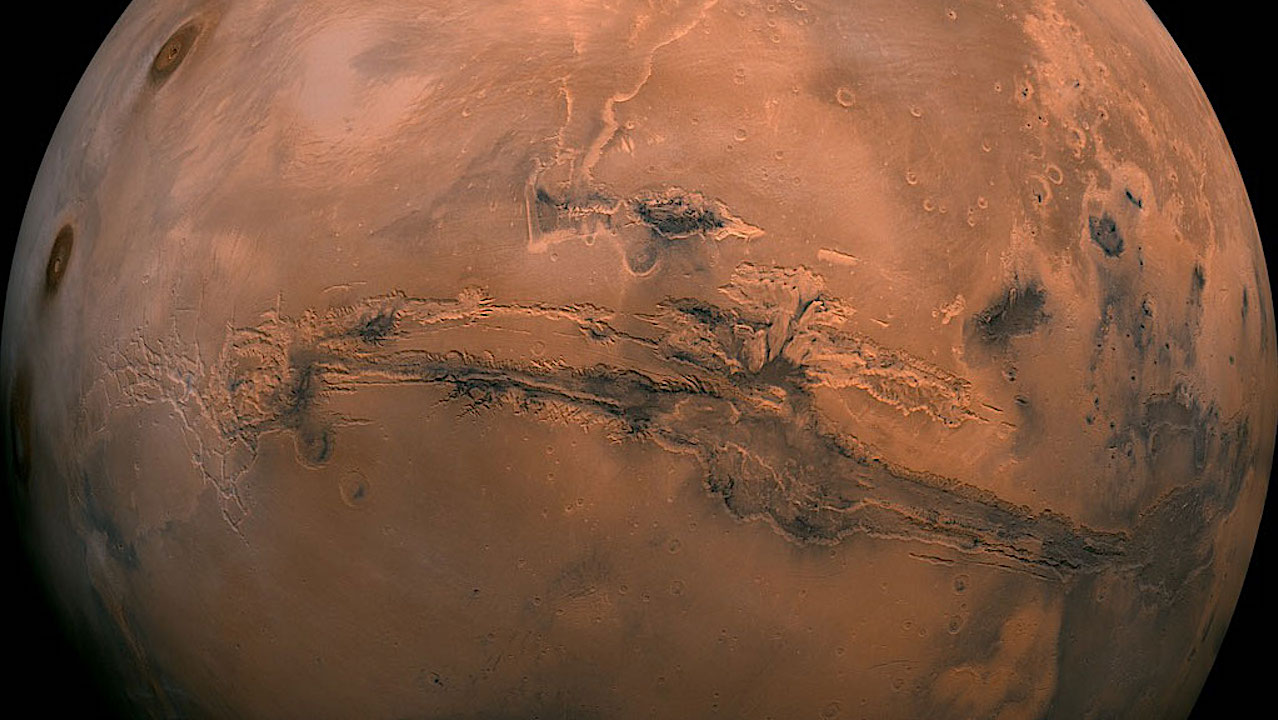
According to a NASA press release, “Imaging scientists Dr. Michael Malin and Dr. Ken Edgett from NASA’s Mars Global Surveyor spacecraft will present what they describe as their most significant discovery yet at a Space Science Update at 2:00 p.m. EST on Thursday, Dec. 7. Their findings are being published in the December 8 issue of Science Magazine.
This science update will be held in the James E. Webb Auditorium at NASA Headquarters, 300 E St., S.W., Washington, DC, and will be carried live on Telstar 5, transponder 11. The Ku-band satellite is located 97 degrees West longitude with a downlink frequency of 11929 MHz, vertical polarity.
Please note that, due to coverage of the ongoing Shuttle mission, NASA Television does not expect to carry this briefing, and two- way question-and-answer capability from agency centers will not be available.
The indivudals participating in this press conference will be:
Dr. Ed Weiler, Associate Administrator for Space Science, NASA Headquarters, Washington, DC., (moderator).
Dr. Michael Malin principal investigator, Mars Orbiter Camera on NASA’s Mars Global Surveyor spacecraft at Malin Space Science Systems (MSSS), San Diego, CA.
Dr. Ken Edgett, staff scientist at MSSS.
Dr. Jim Garvin, Mars Exploration Program Scientist at NASA Headquarters.
Dr. Ken Nealson, director of the Center for Life Detection at NASA’s Jet Propulsion Laboratory, Pasadena, CA.
The presence of an astrobiologist on the panel has had many people speculating about the nature of the new discovery. It should be noted that an Astrobiologist (Bruce Jakosky) was also present at the June 2000 press briefing regarding the discovery of liquid water near the surface of Mars. Jakosky was able to provide insight into the implications of that discovery for life on Mars even though that discovery had no direct or indirect biological component to it. As such, it is likely that Ken Nealson, who has specialized in looking into the “biomarkers or “life’s signatures” that might allow a determination of life’s presence on a planet from afar.
While NASA has been rather tight lipped about what this discovery is, some general indications appeared in the 2 December 2000 issue of the Sunday Times in London: “NASA scientists have discovered ancient sea or lake beds on the surface of Mars that could once have harboured life, writes Jonathan Leake. The discovery is among the most significant concerning Mars so far, because such places are the most likely locations for fossils or other signs of past life. Nasa will announce the discovery in this week’s edition of Science with the suggestion that the next generation of Mars landings should be sent to such areas.“
If indeed this is what is going to be announced it is rather curious – since Malin and Edgett have made previous statements that they did not see evidence for ancient oceans on Mars. Indeed, they are scheduled to present a paper at the Fall meeting of the American Geophysical Union (AGU) from 15-19 December 2000 titled “MGS MOC and Water on Mars: No Northern Plains Ocean, no Gusev Crater Lake Sediment Access“
However, just as this paper (or at least its abstract) repeats their earlier view that they do not see evidence of large oceans, they do refer to other possible locations that could be more promising:
“Other impact basins, however, do show tantalizing evidence of access to layered sediment (whether subaerial or sublacustrine is unknown); of particular interest is Holden Crater, connected to Uzboi Vallis, which exhibits outcrops of alternating light- and dark-toned bands. Unfortunately, such locations are inaccessible to presently-conceived lander/rover missions which are dictated by engineering constraints rather than science objectives. New MGS MOC images are received every day, and analysis is on-going.”
Reference was also made to Holden crater’s interesting potential at a press conference in August 2000:
“NASA scientists have yet to decide on the exact landing sites, but Mars program scientist Jim Garvin says areas that might have contained large bodies of standing water–such as a crater called Holden–are strong candidates.”
Regardless of what is announced – or whether Holden crater is even involved in the announcement – it is curious that NASA promotes this announcement as being “major” yet won’t cut away from some routine space activity aboard the Space Station so as to allow this news conference to be broadcast on NASA TV – or for reporters to participate from NASA’s field centers as is normally the case.
Related Links
° 2 December 2000: Dried-up sea beds found on Mars, Sunday Times, London
° 1 December 2000: Major Mars Discovery to be Announced at Dec 7 Briefing, NASA PAO
° MGS MOC and Water on Mars: No Northern Plains Ocean, no Gusev Crater Lake Sediment Access, abstract, AGU Fall Meeting.
° Holden Crater floor near intersection with Uzboi Vallis, MGS MOC Image m0302733, USGS
° Landforms on the floor of Holden Crater, MGS MOC Image m0202300, USGS
° Junction of Uzboi Vallis with Holden Crater SW rim, MGS MOC Image m0802225, USGS






Leave a Reply
You must be logged in to post a comment.