


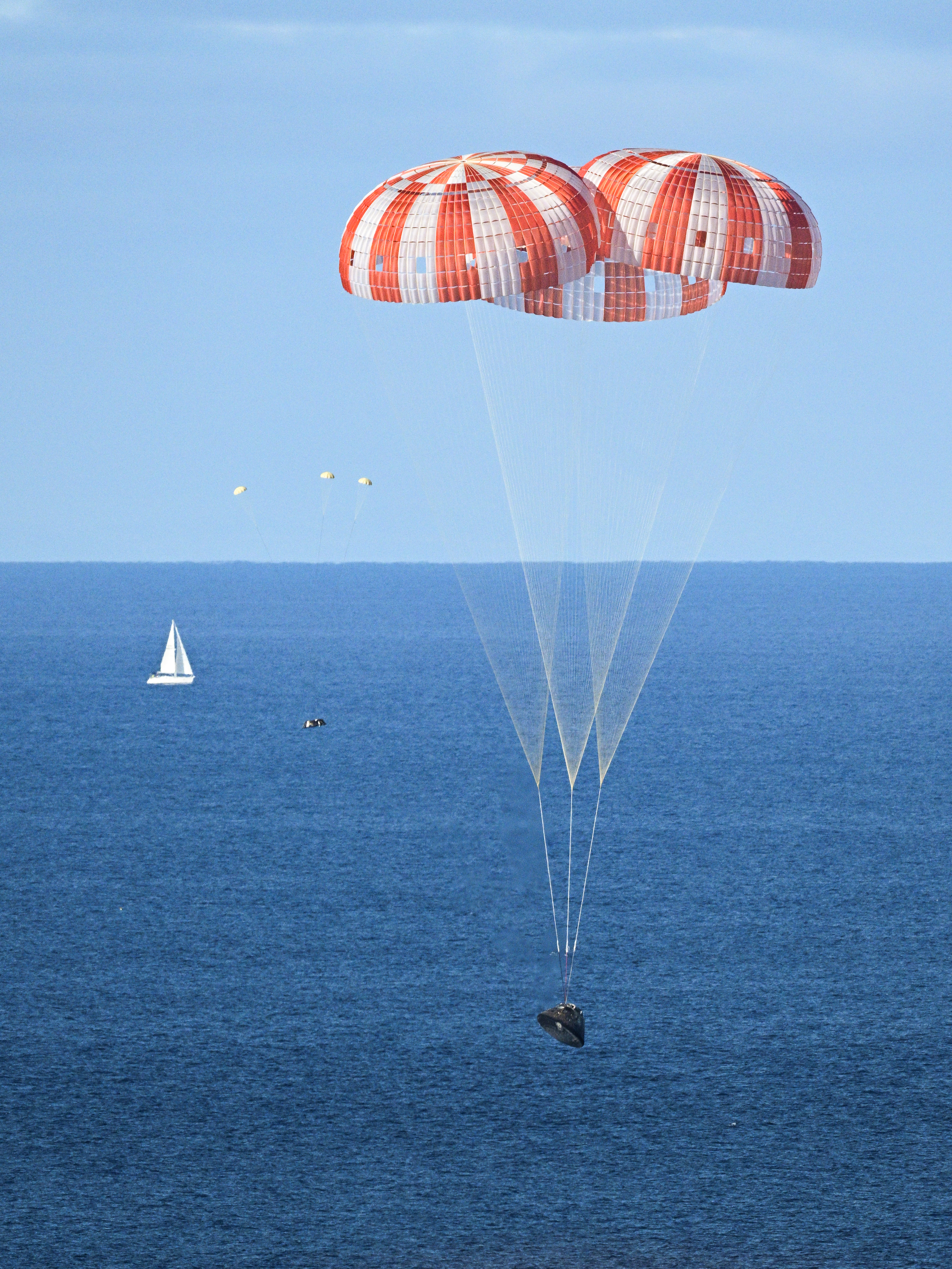
Keith’s note: An enlargement of this image from the splashdown of Artemis II is all over space Twitter. There is a bright colored region on the heat shield. Armchair experts and space influencers all have an opinion. That’s all they have – from one blurry pic. Jared Isaacman @NASAAdmin said this in response. When he has an answer he’ll tell us. So chill and focus on some #MoonJoy. More below
“I am hesitant to get ahead of a proper data review, but I understand the space community’s curiosity, especially when imagery can give the impression of a problem.
As you would expect, engineers were eager to inspect the heat shield, starting with diver imagery shortly after splashdown and continuing with the review aboard the ship. No unexpected conditions were observed. I suspect when the images are released, it will be pretty obvious the stark difference between Artemis I and Artemis II head shield performance.
As to the question specifically, the discoloration was not liberated material. The white color observed corresponds to the compression pad area and is consistent with the local geometry, AVCOAT byproducts, and transitional heating environments. We observed this behavior in arc jet testing and expected it in this compression pad area.
We will complete a full data review across all systems, including the thermal protection system, and make the results publicly available.”

Isaacman should be commended for bringing such openness and transparency to NASA’s manned program. It would be nice if he insisted on the same amount of openness and transparency on other issues, like the White House’s 2027 NASA budget proposal for example. As the head of the Planetary Society (Casey Dreier) states, it has an “astonishing lack of transparency,” and “is the least transparent NASA budget request I’ve ever seen — and I’ve literally looked through every single one since 1960.” To try and hide what the administration is trying to do, the budget proposal doesn’t identify which missions are cancelled in the drastic 47% reduction in NASA science funding and doesn’t provide prior-year funding levels to make it difficult to assess how drastically programs are affected. Yet rather than push for more detail (i.e. openness and transparency) in the budget, Isaacman blithely says he full supports was the administration is proposing. Way to go, administrator!