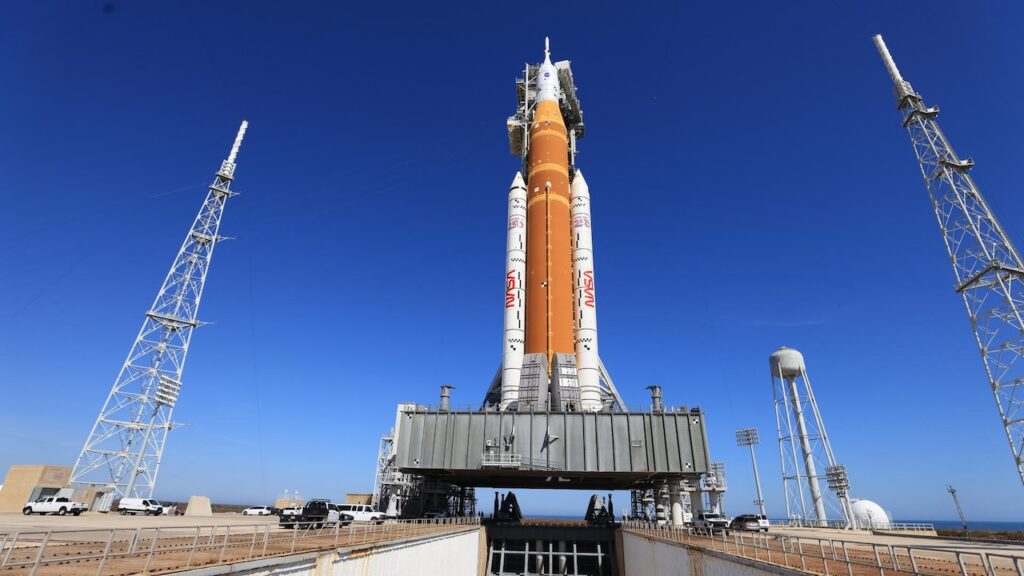
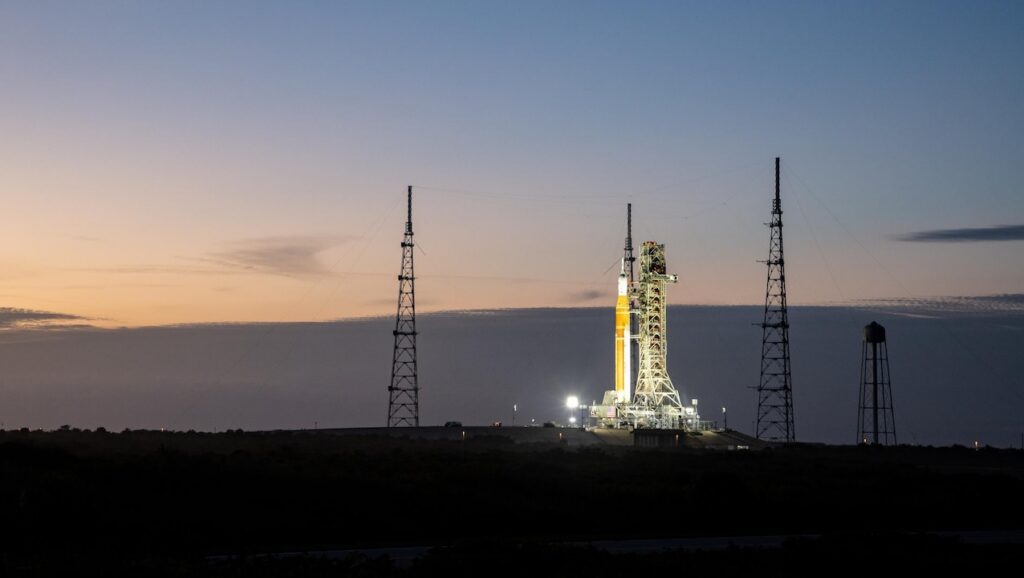
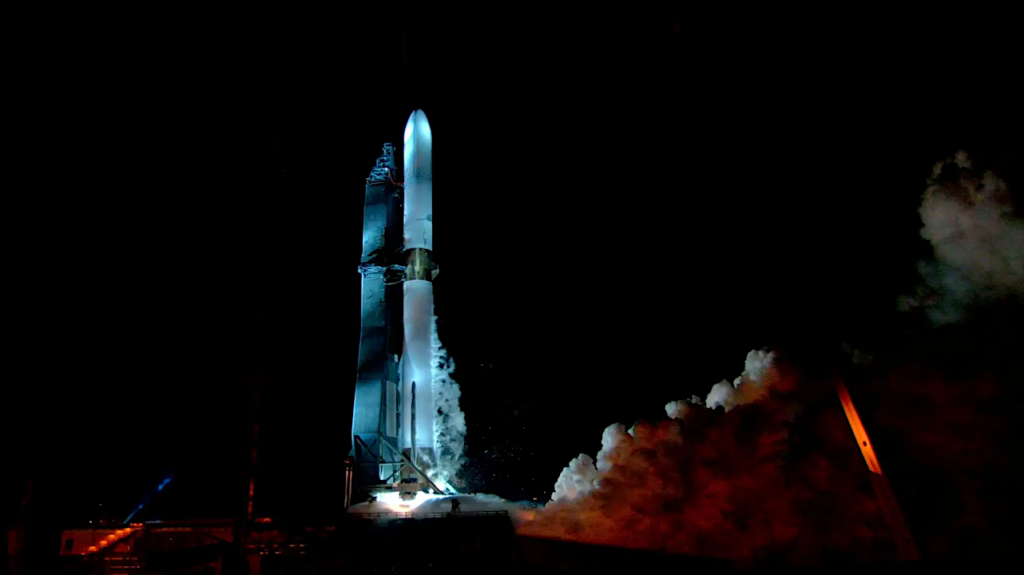
Ares 1-X Launch Scrubbed

Keith's note: According to NASA: "Launch Director Ed Mango informally polled his team to ensure the vehicle and its system are all still "go." The range is not available after noon today due to reasons such as airspace and warning areas, planes operating on flight plans, and other issues. Today's launch window ends at noon.". The Ares 1-X rocket itself is all green and good to go. Winds have started to trend down and have hit - but not exceeded - the limit.

NASA was looking for a 11:20 am EDT count resume for a 11:24 am EDT launch. Weather is green on triboelectrification and is red on wind. Weather officer says that conditions for T=0 will be red for triboelectrification. LC says "We are not going to resume."

Heard on MSNBC at 8:00 am EDT:

Mika Brzezinski: "The flight will last 2 minutes and cost $400 million"
Joe Scarborough: "USA!!"

Heard on MSNBC at 9:48 am EDT: Jay Barbree says that Orion will carry a crew of "as many as 6 astronauts" and that the Ares 1 is the "best designed" and "safest rocket ever designed" .

Heard on MSNBC at 9:57 am EDT: Jay Barbree says "We have new people who do not have experience in this office who are trying to go through a commercial launch [for crew] and if they do it will be a delay for at least a decade before we have [something for] astronauts from this country to fly upon."


Advertise Here

28 Comments

| Leave a comment

Well, I hope the weather is a go for here and there.. I'm more than a few miles away and its not going up very high so I may not see it but I will see it online.Lets hope the "Get it right twice" plan for the next NASA program goes as planned. I am actually hopeful after lcross and the pr mess that ensued thereafter.So that being said Good Luck in collecting useful data and have a good launch.

On a side note ; Any word on that LCROSS data?

Love it or hate it, GO ARES 1-X today!!!

Go Ares Team!

(And unzip it at Max-Q!)

What a ridiculous contraption. What a ridiculous goal (to demonstrate ESAS 'progress'). What a waste of my tax dollars.

American HSF for the foreseeable future (remaining Shuttle flights not withstanding) may hinge on the success of this test. GO ARES 1X!!!!!!!

Keith suggestion for website: it would be nice if you added an auto refresh feature to website.

Eagle Eye: that is why browsers have had their own refresh button since day one. People complain when the page they are reading suddenly refreshes with no warning.

Sorry, I just shake my head when I hear this cost. The big gripe with the Space shuttle was the cost before the Columbia accident made safety the big issue. Yet none of these new designs for crew or commercial resupply to the ISS beat its cost. I have posted a crude analysis of the commercial contracts with SpaceX and Orbital and Soyuz and Progress vs the Shuttle and to launch the same number of astronauts and supplies they are always more.
So what type of progress has NASA made to lower the cost of space travel? NONE.

I am so tired of the lies. There are so many problems with this launch vehicle, most importantly it is just too weak to do a good job. So much more could be done using a vehicle like the DIRECT launcher!

That being said, good luck with today's launch, if the weather cooperates!

Scrubbed. Try again tomorrow.

dbooker: "Yet none of these new designs for crew or commercial resupply to the ISS beat its cost."

The Augustine Committee differs with your analysis. From Page 13 of the Final Report:

The United States needs a means of launching astronauts to low-Earth orbit, but it does not necessarily have to be provided by the government. As we move from the complex, reusable Shuttle back to a simpler, smaller capsule, it is appropriate to consider turning this transport service over to the commercial sector. This approach is not without technical and programmatic risks, but it creates the possibility of lower operating costs for the system and potentially accelerates the availability of U.S. access to low-Earth orbit by about a year, to 2016. If this option is chosen, the Committee suggests establishing a new competition for this service, in which both large and small companies could participate.

The Final Report goes further on Page 14:

Establishing these commercial opportunities could increase launch volume and potentially lower costs to NASA and all other launch services customers.

Lastly, all but two of the Final Report options present Commercial Crew to LEO.

Maybe its time for Jay to retire...he made a fool of himself in the briefing with a comment regarding cost to date of $400 to $500 Billion...
but later corrected himself to 4 or 5.

Much to the credit of the NASA panel they didn't blink an eye.

At one point in the countdown, the clock reached T minus 2:39 when a hold was placed because of a wayward cargo ship. Had that ship not been where it shouldn't have been, the launch might have taken place today instead of being scrubbed.

Now, I know that NASA issues timely Notice to Mariners warnings. And everyone knows that rockets have been rising from Florida's eastern coast for the past half century. And there's the story about a ship that was damaged by a discarded booster stage and the owners sued. And then there's that rumor about a ship that was hit and sunk by a falling stage, never to be heard from again.

The next time a rocket is waiting to go and a ship is found in the no-sail zone, I say launch anyway. If the ship gets whacked, it's evolution in action.

Sorry, I just shake my head when I hear this cost. The big gripe with the Space shuttle was the cost before the Columbia accident made safety the big issue. Yet none of these new designs for crew or commercial resupply to the ISS beat its cost. I have posted a crude analysis of the commercial contracts with SpaceX and Orbital and Soyuz and Progress vs the Shuttle and to launch the same number of astronauts and supplies they are always more.
So what type of progress has NASA made to lower the cost of space travel? NONE.

And I MAY have a bridge in Brooklyn to sell you.

Poor Jay Barbree continues to party like it's 1969...only it's not.

Jay Barbree, Helen Thomas. Where are the good old days when the only dinosaurs were fossils. The fact that news organizations keep people past their prime and allow them to embarrass themselves I think says more about the organizations than the reporters who were top in their fields at there prime. Unfortunately their prime was the same time as the last Apollo mission.
It is a sad state of the news you get now. You see news anchors all of the time commenting on shuttle or other space missions that don't have a clue as to what they are reporting on and just spouting misinformation. Uncle Walter and Frank Reynolds and the others never did this. I guess that is the difference between real reporters and the talking heads we get now.

One last comment on the ARES 1X. Guess NASA should look into subcontracting to the Grucci's. The always seem to be able to launch their fireworks no matter what the weather.

Isn't it a bit disingenuous to refer to this launch as having cost $445 million dollars? Isn't it $445 million for developing the whole program so far?

Isn't it a bit disingenuous to refer to this launch as having cost $445 million dollars? Isn't it $445 million for developing the whole program so far?

The Constellation program has cost something over $8 billion. NASA released cost data just for this flight of something close to $400 million.

The dollar value has gotten a lot of [negative] attention from the press. I've heard commentators say 'how can NASA be spending this much money for a two minute test when the economy is in the state its in'. They think the green bills are being launched in the rocket and will fall into the ocean. NASA should have done a better job of saying that this flight has been in development for several years, is now about a year late, and the money has gone into the salaries of about a thousand people over several years.

Of course, its still hard to believe that it is costing that many people's hard work just to launch a Shuttle SRB with some mock-ups bolted to the top.

I'm curious to know what the real cost of the Ares 1x was. If the people and facilities were not charging to an Ares 1x charge number (assuming they are) what would they be charging to? For example, I feel the cost of an empty Vehicle Assembly Building should be factored out of the Ares IX cost but I assume that under full cost accounting when the Ares 1X is assembled inside the VAB that the cost of the facility is being charged to an Ares 1X charge number. And, maybe, even empty time for the VAB is spread across projects. I think that is the way wind tunnels are accounted for also. Please correct me if I am wrong.

Hopefully the weather.....and commercial shipping.....will cooperate tomorrow.

Without getting into the Ares/Direct/STS/cost fray and argument whether or not lies are being spread, perhaps this launch will be a good bit of publicity, the sort that NASA needs. After all, CNN had updates on the launch through out the morning, referring to the "world's largest rocket." NASA needs all the good press it can get. Maybe a bit of that press will sway some opinions on the hill and on Pennsylvania Ave.

The Augustine commission does not provide the data to back its assertion that commercial is cheaper. The Shuttle puts up 7 astronauts and 50,000 lbs of cargo, depending on whose numbers you believe. At $50 million per seat on Soyuz, that's $350 million. At $5,000 to $10,000 per pound of payload to orbit, that's another $250 to $500 million. That totals $600 to $850 million to duplicate one Shuttle launch. A Shuttle launch costs around $500 million, again depending on whose numbers you believe. If commercial is cheaper, it has yet to be demonstrated. As for Ares 1-X, today's attempt was an embarrassment. With a 20-knot wind limit for launch, this thing may never leave the ground. If they can't launch on a day like today, they can't launch. The Shuttle wouldv'e been outta here.

It's not unusual at all to have tighter flight rules for test flights. I'd say it's pretty normal, depending on the test goals for that flight and the given project's state of development. There was naught wrong with the wind limit.

I hope it goes tomorrow. I want to see a X-class model rocket launch!

We should be watching OSP's first autonomous test launch and landing. Instead we get the results of a moment in time after STS-107 where enough people cared about America's future in space for long enough to get the previous administration to act like it cared too.

now have a look at the date on this:

By Eric Berger, Houston Chronicle Knight Ridder/Tribune Business News

Feb. 11, 2003 -- The director of the program to build an orbital space plane said Monday that administrators have told him to continue development of the vehicle in time for a 2010 liftoff.
In November, NASA administrator Sean O'Keefe shifted the focus of future research from a next-generation shuttle to a plane that could taxi crews to and from the space station in a safer, cheaper way.
"We've been given pretty clear direction, which is to implement the plan, and we're doing that,"

Now that Shuttle's development costs are far sunk, I agree that it is a much more affordable launch vehicle than Constellation's Ares, by almost any measure - total life cycle, average and marginal cost. The $2 billion average cost per flight of Ares 1 blew me away.

To start comparing Shuttle costs to commercial launch, NASA's 2008 budget for Shuttle was $3.2 billion and in 2009 was $2.9 billion. Divide that by an average of five flights per year and you're looking at $580 million to $650 million per flight - near your $500 million figure.

However, if you disaggregate the requirements for delivery of crew and cargo given the demands at Station, the Shuttle lift capacity is oversize and the launch cost less affordable - once Station assembly is complete.

Compare with the $3.5 billion Commercial Resupply Services (CRS) for cargo delivery to Station from 2011 to 2016. NASA could try to keep Shuttle flying at a low rate instead of pursuing CRS, but, given the reference cost of the stand-down post Columbia (Shuttle was still burning up $2-3 billion a year without a single launch) the Shuttle would still not be cost effective given the operational resupply demand of Station.

For crew transportation to Station, using your calculated price of $50 million per seat on Soyuz, let's assume NASA needs to fly ten astronauts to Station each year. That would still only amount to $500 million per year at Russia's extortion pricing.

I suppose if NASA could minimize Shuttle program costs to below $1.5 billion a year from the remainder of Station operations, it could be the more affordable option.

Leave a comment


Monthly Archives

Mortgage Lead

online bingo latest online bingo game reviews, bonuses and bingo news

Play online bingo at the top bingo sites.

Interested in Space Travel, try the next best thing, name your own star.

About this Entry

This page contains a single entry by Keith Cowing published on October 27, 2009 11:23 AM.

Mini Me at NASA Too was the previous entry in this blog.

A New Challenger Learning Center Opens is the next entry in this blog.

Find recent content on the main index or look in the archives to find all content.


- RADWIN's broadband access enabels cellular carriers to connect users everywhere.

- Looking for great prices on Burton Snowboards? Visit PortersTahoe.com

-