Ares 1-X Staging Issue

Ares I-X rocket chalks up successful test flight, CNet

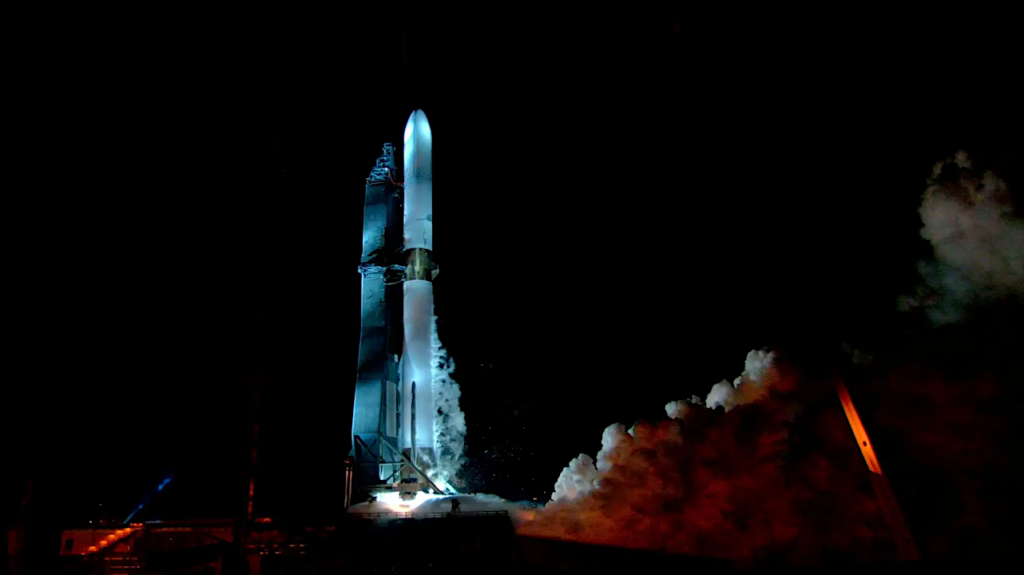
"But in a departure from the expected flight program, the dummy second stage went into a flat tumble as it continued along its ballistic trajectory instead of maintaining a nose-forward orientation. The dummy upper stage rose to a maximum altitude of about 150,000 feet before arcing over and plunging back to Earth 150 miles east of the space center."

'We stand today on the shoulders of giants,' rocket manager says, Huntsville Times

"One area of concern comes from the separation of the first-stage solid rocket booster and the upper stage mockup, Davis said. "We are looking into that. It appeared the upper stage could have come back and made contact with the first-stage booster," he said. "That's what testing a design is all about, though. We've had some concerns, and now we've got hard information coming back so we can improve on Ares."

Ares test launch helps NASA 'avoid potential political damage', Huntsville Times

"Griffin, who is working to develop a Center for Systems Studies at UAH, watched the launch on his computer. "It was marvelous," he said. "It was right on trajectory the whole way."

Keith's note: In this NASA CGI video of a computer simulation of the Ares 1-X, the first stage is shown slowly tumbling at staging and the second stage is shown flying on straight after staging only to start tumbling later. But the actual flight shows the first stage in steady flight and the second stage flying almost backward. According to Bill Harwood's article in CNet, Mission Manager Bob Ess said "So far, we're on a path to learn a lot. The separation seemed a little different than we predicted as far as how the upper stage reacted after separation. So right there's an opportunity for us to jump in and figure out what was different in the actual flight from our models. So, hugely successful."? AS for Mike Griffin's comment about the rocket being "right on trajectory" I am going to assume that he shut off the video feed before staging.

Hmm, had there been a crew in a real capsule on a real second stage this might have been a slight problem. Yes, there was no second stage motor. But what if there was a real motor and it failed to start? One would think, at a minimum, that you'd like to have a design that defaults to a safe stage separation regardless of whether second stage ignition occurs such that a crew abort could be initiated. Its these high altitude abort scenarios that NASA managers often wave around to disqualify EELVs for use with human crews.

Then again, this was a flight test. And this aspect of the flight of Ares 1-X demonstrates precisely why they are valuable.

Advertise Here

46 Comments

| Leave a comment

"Then again, this was a flight test. And this aspect of the flight of Ares 1-X demonstrates precisely why they are valuable."

Exactly.

Testing is where you match the models to the real world, find out the real-world problems, and correct them.

If the first stage had a real fifth segment instead of a dummy one, staging would have happened at a higher altitude.

Would this have meant less air drag pushing the second stage back towards the first, or was it already high enough that it wasn't a factor?

You guys don't give anything nasa does a break, all test objectives were met, it's a good thing you don't know the rest of the story.

But I am sure you'll keep digging!

Well they'll have to revisit the forces at separation and figure out what wasn't accounted for. Yes, it is what testing is for. I half expected more things to go wrong. It was a pretty awesome flight.

Roger, I don't think the air drag is an issue as you put it. It certainly plays into staging but they should probably be able to stage it at various altitudes so they would have some margin there.

I couldn't see any recontacting like some people have been mentioning unless it happened really close to separation. I wonder if they did something different than normal at separation. I saw in the animation there are small rockets on the 2nd stage that fire to provide a little thrust forward. Maybe those were an issue? Was the direction of travel through the air different than expected at separation? Did the deceleration rockets on the 1st stage fire too early, before separation? That could certainly cause some instability. I'm sure they'll figure it out.

Couple things to notice. First, during the press conference, I remember them saying (I think) that they encountered lower than expected loads. Now, watch the video closely right before, during and after sep. Mission control calls out main engine tail off, but the video still shows a good healthy plume. Of course, there could be audio/video sync problems, too. It looked like there was still a good amount of forward propulsion at sep. It could be the first stage nudged the upper stage a bit, sending it into a spin. If the loads were low enough, I would think you could have a small error on the engine cut-off/sep timing.

If this had been a full test, the upper stage would have had power and RCS control.

Overall, a good test and they should learn a lot.

Roger makes a good point and that is why I think this test was a waste of money, especially since they had just test fired a 5 segment on the ground in Sept. Why didn't they just wait and use at least a true 5 segment?

I baffled by what I'm hearing in the press and from sources such as the AIA. They congratulate NASA and tout this as the first new man-rated rocket in 37 years. Something that Jay Barbree also said in the after launch press conference love fest.

THIS WAS NOT A MAN-RATED ROCKET!!! Please stop telling these lies. It wasn't the equivalent to a sub-orbital Redstone booster test from the early 60s because at least those were the TRUE boosters to be used. This was a 4 segment, with a different fuel formula and a different casting mold.

Sorry, I'm not impressed by this kluge. I also question the value of any data that is gained from this "test".

If this test rocket is considered man-rated then I guess Steve Eves beat NASA by launching his Saturn V back in April.
http://thelaunchpad.xprize.org/2009/04/video-world-largest-model-rocket-saturn.html

And note that ALL of his recovery parachutes worked. I'm sure he didn't spend tens of millions on testing them either.

dmso - I agree :) Keith is definitely hard on them. It's very cool for him to bring this up and that we're discussing this issue because certainly NASA is, as they should. You won't hear things like this in other media. However, it was toned a bit negatively there with just a little "but this was a test" at the end.

I think it was a fantastic flight and great job to everybody involved!

Question: Why did the upper stage simulator tumble?

Answer: There were no Solids on the upper stage

If you slow down the video it looks like the lower stage starts to turn fractionally before the upper stage does (hard to tell due to shakey camera; I held a straight edge against my screen) suggesting that it caused the tumble by contact just after separation. After the 1st stage appeared to burn out, it seems to have a last gasp at the same time as the decceleration rockets fire.

Another possibility might be that the decceleration rockets didn't fire uniformally in each direction or in synch causing the lower stage to turn while separating the upper stage. It could even be that the separation firings were not uniform.

Whatever it is I'd bet they can fix it if they get the chance. A good and useful test it seems.

According to what I heard NASA say the upper stage dummy was what the "current" design mold lines would be and that it had the equivalent weight ballasted with steel plates. Of course I doubt the weight distribution would have been the same as liquid H and O but I may be wrong.
But r0ck3tman has a point. There was no post separation ullage motor which would ignite to ensure that the liquids would properly feed the J2x engine and at the same time provide continued momentum for separation.

NASA had a successful launch and test flight with Ares 1-X. Data from over 700 sensors was received and compiled which will take several months to analyze. The Ares I team deserves congratulations for all their hard work and dedication. In just three years, this team was able design, build, and launch a prototype despite the negative, excessive criticisms of the program. Kudos.

"Of course I doubt the weight distribution would have been the same as liquid H and O but I may be wrong. "

The ballast plates in the Upper Stage were placed at the exact centers of gravity where each of the tanks would be.

Since we are talking about liquid fuel, I doubt that it would be "exact" as the liquid in the tanks would have a different center of gravity when rocket is 100% vertical at liftoff vs inclined at burnout as was observed during flight. The tanks aren't filled to 100% capacity and the liquid would tend to slosh when the momentum from the solids stopped thus the need for the ullage motors prior to liquid booster ignition.

Wouldnt there have been separation pyros on the true second stage( or 5th segment)? Like the ring sections on the old Saturn 5 rockets. not to mention a boost after separation. But it did list to one side I agree with the comment on higher means less drag. What upset me was the NEWS GUY saying its just a suborbital flight.. It wasn't even close to sub orbital.. It needed to go another 40 miles for a suborbital flight to be achieved.I noted it when the flight controller said Mach 4 ( aprox 2600 mph). So they are saying the second stage is going to achieve the difference up to 17,500 mph required from orbit?

Interesting observations by all.

I'll wait until the results of data is analyzed.

All in all, a VERY good effort by the NASA folks.

What a naysayer! The contrarian comments of dbooker that trivialize this test flight as nothing more than a kluge and a waste of money, and question the value of any data gained, are absurd in the extreme. The irrational bleating of the disaffected who can do nothing but sit on the sidelines and find fault. But he does NASA a favor by couching his criticisms in terms that place him firmly in the camp of those to be dismissed as irrelevant.

I'm not surprised at all that the 2nd stage spun out after sep, it got rear-ended by the SRM. Of course there would have been re-contact in this configuration. There was still thrust from the SRM, and separating the stages with no way to either decelerate the 1st stage or accelerate the 2nd stage away from the booster is the sure fire recipe for recontact. This will also be a BIG problem for the real stack if not properly accounted for. This is one of the advantages of liquid boosters - shut down the engine(s) and shortly thereafter there is no thrust to content with - just make sure the nose is pointed the right way when you do it. SRM's by nature provide some level of thrust until their propellant is expended (especially in very thin air) or the chamber is vented sufficiently to relieve thrust in the direction of travel.

I'd like to congratulate NASA on a test flight that went as well as it did. There are always issues and I'm glad to see that a truly major one did not occur.

Can someone post the planned staging sequence and timing for the first and second stage for this test?

I'm guessing that the plan was to move the SRB, and the parachutes at the top, away from the second stage before any major motor firing occurs on the second stage. Is this true or not?

At this moment (and maybe even yesterday) the NASA engineers may already know what transpired. Has someone explicitly heard what the NASA engineers believe to be the top level cause of this?

"The contrarian comments of dbooker that trivialize this test flight as nothing more than a kluge and a waste of money, and question the value of any data gained, are absurd in the extreme"

Incorrect. The vehicle was a kludge, a term that even applies to the real Ares I. The marginal data collected on the flight was not worth 1/2billion dollars. This was a PR stunt, an admiral's test and nothing more. The shuttle didn't need a test flight nor do other ELV's.

The shuttle didn't need a test flight nor do other ELV's.
@me To correct you there was no shuttle test launch but there were plenty of flight test.. "Enterprise underwent five free flights where the craft separated from the SCA and was landed under astronaut control. These tests verified the flight characteristics of the orbiter design and were carried out under several aerodynamic and weight configurations. "

>The shuttle didn't need a test flight nor do other ELV's.

Really? :)

http://www.nasa.gov/mission_pages/shuttle/sts1/sts1_crippen_young_intvw.html

Quote:

"Ultimately, STS-1 was a bold TEST flight to determine if a rocket launch into space could be a round-trip ticket."

"The shuttle didn't need a test flight nor do other ELV's."

What about the Enterprise? The Enterprise never went to space, it was launched into air off a jet as an aerodynamics test article.

Isn't that what Ares-IX is? An aerodynamics test article, just to spot things like the spin-out observed today?

SRB parachutes were also tested. But these and the Enterprise flight tests had nothing to do with the shuttle as a launch vehicle. So my point stands.

"This will also be a BIG problem for the real stack if not properly accounted for."

Real stack will have USMs and sep at a different spot.

"This is one of the advantages of liquid boosters - shut down the engine(s) and shortly thereafter there is no thrust to content with - just make sure the nose is pointed the right way when you do it."

Tell that to SpaceX

Granted, a discussion can be had about how much of the Ares-IX vehicle should have been real and how much of the test was driving by non engineering concerns. But, your comment reads as if test flights should not be done. When the Shuttle went up for the first time, that was scary. And there was a lot of nail bitting and second guessing before and during the launch. And, at the moment, I can think of quite a number of tests or first flights of new systems for NASA, DoD, and commercial which were not successful. So, maybe the question should be asked, why did the Shuttle launch system not have an unmanned test flight? And, does the answer to that question apply to the Ares 1?

I meant the shuttle did not need a test flight like Ares I-X. There was nothing different configurationwise between STS-1 and follow on missions. Ares I-X is nowhere near like Ares I.
The shuttle and current LV did/do not need partial configuration test flights. STS and current LV's flew their first flight in fullup configurations.
So my point still stands.

Ares I will fly unmanned for the first flight.

It's a straightforward question -- is there anything radically different about the upper stage in terms of aerodynamics (center of pressure, etc), or CG, etc, that would make this tumble irrelevant to the production vehicle? Or did the tumble in fact happen because of recontact, or less than clean sep, or whatever? Does the production stage have a different separation plane than this vehicle, and would that affect the stability? (Does the cone stay on the SRB on the production version?)

The whole point is the fidelity of this test to the production vehicle. If was high-fidelity, then it seems like a problem. The stage shouldn't tumble, right? It should fly on rails for the short period before the J-2 comes up to power and can control the stage.

If it's not high-fidelity, then there's the question of the meaningfulness of this flight. Which way is it? Should we just not care that the tumble happened? Would it have been a survivable event in a manned vehicle? Y/N?

"The shuttle didn't need a test flight nor do other ELV's."

ELV's did need test flights. "Heavy Demo" was the flight of the Delta IV Heavy in Dec. 2004. And, FYI, it had propellant problems and FAILED TO ACHIEVE THE INTENDED ORBIT.

The first shuttle launch SHOULD have been an unmanned test. Young was quoted as saying that if he knew how badly the acoustics had loaded the flight surfaces at lift-off, they would have ejected. (Now we have the water sound suppression system) The flight computer also almost lost control during re-entry.

The shuttle wasn't an unmanned flight test because of the technical challenges associated with flying it remotely with so many unknowns in 1981.

Apollo 6, which was also an unmanned flight, almost shook itself apart and had severe structural damage due to POGO oscillations.

Anyone who says unmanned test flights aren't a good idea hasn't worked in the business or is arrogant and ignorant.

Dave

Apollo 16-17 & Skylab apparently flew without second stage ullage motors to save weight. It takes some finite time before any ullage migrates to a spot where it will cause problems.


As noted Spacex experienced a longer than expected thrust transient on engine shutdown on their 3rd flight, but still I think for liquid fueled rockets, it's a fairly short duration phenomenon.


It would have been nice to have a video of the separation from a rocket cam as Spacex had...


It wasn't immediately obvious that the two stages collided, but I imagine the aerodynamic forces are fairly small at that altitude, so it must have been that the separation was not clean.

NASA CxP has gone above & beyond to incessantly blab on & on about their Superior internal analysis and discrediting of dissent: Augustine panel, 45th
Space Wing, etc. Ref the 45th discredit campaign
http://nasawatch.com/archives/2009/07/ares-1-abort-study-update.html#comments and the Ares PDR fiasco for starts.

Also, the public trash talk from their Top-Down CxP mgmt is nothing compared to the inside bullying, harrassment, & "dealing with" dissent from the troops in the trenches. (Ref the Wayne Hale video).

All the blasting from NASA CxP towards dissenting was based on touting their fancy new "Supercomputers" that allegedly proved CxP dissenters wrong.

So, this Ares 1-X "test" was hyped as a first new technology demonstrator, but it seems to have only demonstrated critical flaws in their analysis.

There's a few reporters that have gotten back to reality.

AP's reporting it now, but Harwood got the inside scoop first:

NASA assessing dented booster from Ares 1-X launch
http://www.spaceflightnow.com/ares1x/091029dent/

Also, interestingly Harwood earlier reported that an aircraft person claimed they saw all 3 chutes, but apparently not:

Ares 1-X Parachutes Fail
http://www.floridatoday.com/content/blogs/space/2009/10/live-at-ksc-ares-i-x-parachutes-fail.shtml

Also, a Padrat on NSF is reporting 2 serious hydrazine leaks at Pad B, one yesterday & one this morning plus the pad was apparently damaged excessively more than usual. Haven't seen a news report yet though.


Just seems like the CxP folks are too close and probably needs an indepedent technical review (Gerst & Shannon, S&MA, or USAF Rocket persons, or something) because it seems like the troops are leaking because there may be internal concerns that the CxP commanders may not be as objective in their forthcoming "analysis" as they ought to be.

@giskard03

Read my post " The shuttle and current LV did/do not need partial configuration test flights. STS and current LV's flew their first flight in fullup configurations."

Anyone who says test flights are reguirement hasn't worked in the business or is arrogant and ignorant.
See Delta IV & Atlas V first launch.

OK, next question -- did recontact/dirty sep damage the chutes?

At least one of the older videos of the flight shows ullage motors on the upper stage simulator. I wonder why they were deleted?

1. I'm not opposed to test flights. However, this was the equivalent of the Honda Racing team testing an Accord in place of their Formula 1 car. Yes the both have an engine, 4 wheels and a driver but the performance of the 2 aren't close.
2. The design doesn't make sense. The cost of this test was almost the same as an operational shuttle flight that can launch 7 astronauts and 35,000 pounds. And I don't buy that they are going to get cheaper when the real thing flies.
3. This isn't a moon rocket. This will only get 4 astronauts to orbit. Whether going to the Moon, Mars or and asteroid you would need an earth departure stage which the plan now calls for a launch of the ARES 5. We already have a launch system that can get 7 astronauts to orbit.
4. Don't try the safety issue. We just lost 14 folks in helicopter crashes. Helicopters have been flying for what, 60 years? Risky things sometimes don't go right and people die. What have to do is reduce the risk as much as you can which has been done for the 2 failure mechanisms in the Challenger and Columbia losses.
5. No, I'm not a shuttle bigot. Just develop something that will exceed its capabilities and I will be the first to get in line to congratulate NASA.

How come test flying a shuttle without any rockets doesn't count as a partial configuration test flight?

I want to understand what the difference is. If A1X is to test various systems, and the aerodynamic behavior, doesn't that make it pretty much the same thing as Enterprise?

I know its hyped up like its an Ares I "beta", but isn't this just testing certain components in isolation, like when they fired the 5-segment SRM on the ground, or when they fired the launch escape rocket?

Couldn't we just as well call those "partial configuration test flights" if they weren't bolted to the ground?

Rotation could be an artifact of the separation charges or thrusters firing just prior. Inspect the top cover of the SRB for dents. No dings means no meaningful contact, although it may have been uncomfortably close. It doesn't seem to be a real problem yet.

I think we should just be happy for the Ares crew having a successful and safe launch. Doesn't matter what people say, launching rockets is never simple or carefree.
That they can pull it off and make it look easy is a good thing.

Having just watched the video, I think the reason for the problem is that the 1st stage is 'chugging' during the thrust tail-off. 'Chugging' is a phenomenon inherent to solid rocket motors, especially in a vacuum. What happens is that as the chamber pressure decays, the fluid and acoustic environment leads to pressure oscillations and thus thrust oscillations. This is visible here as the plume dims and flares just before and during separation, with a large flare right at the moment of separation, AFTER the deceleration BSM motors have fired. This leads me to suspect that there was an unexpected thrust increase, possibly leading to re-contact or some type of corrective steering action by the booster nozzle, imparting yaw to the base of the dummy upper stage, causing the spin.

Seems like this problem may be worse with a larger 5-segment chamber and even less back-pressure (IE atmospheric pressure) at altitude to dampen the chugging. They will need to pull the upper stage away hard or ride out the thrust tail off to get around this, I would think.

The reason this was not a problem on shuttle (my opinion) is that the boosters get kicked off the sides of the vehicle, which is obviously accelerating under its own power, so it's immaterial how much shucking and jiving the boosters do after they come off. Here, the booster is directly behind the upper stage, which is not initially accelerating under full power. Unless you want to ignite and run up your second stage engine while you're still attached to the first stage. Sounds rowdy...

I first of all would like to agree with "dbooker". His comments are about as true as you can get on this subject.

Test flights have been used throughout rocket history. This was not a test flight. This was a PR stunt involving the largest model rocket ever flown. A test flight involves using as much of the production unit as possible, tested in a way to simulate the actual flight dynamics in the most real time, real life way possible. The only thing real about this was that NASA did launch something, and it did fly.

Test flying is not something you do to look good. Good engineers know that even the best looking test flights can have serious problems underlining it. Good engineers also know that serious test flying doesn't involve just throwing something downrange to say "We did something". What NASA did is a shame.

Time to REBOOT NASA.


This is funny. Now NASA is going to emphasise how much the 1-Ex test article was not like the "production" vehicle. A kluge of a kluge.

While I cannot say that it will behave significantly differently, the entire size and shape of the nose in the vicinity of the Orion on the real vehicle is different. On 1X they used a simple conical attachment structure for the escape system mounted on top of the Orion mold line and on the real vehicle they are supposed to have an ogive shroud completely covering the Orion.

Aerodynamically, during atmospheric flight, the shape of the nose is quite significant so this is one more area that probably had little bearing on what a real vehicle would do.

It would be interesting to see the detailed requirements and cost history for this launch. If the Constellation Program and if their public affairs arm had done their jobs, there would be little reason for people to be speculating about why the cost was so high or why the test and what they might have learned.

The most sensible explanation I've heard was that this was a training exercise for people who had not integrated and flown anything other than Shuttles. Half a billion for a training exercise seems a bit high. But then, having spent nearly $10 billion and more than 4 years, and only just now having got to PDR is a bit exorbitant of time and mnoney also.

Also, since no more flights are planned for another five or six years, its hard to believe that anything learned by anyone involved in this exercise would stick for the next one.

But as I say, this is all speculation. I'd like to see the real documentation of requirements and dollars. If of course this could be shown to simply have been a PR exercise with no significant technical value, then some of the management probably need to be investigated for gross negligence and waste of government funds.

The changes between the Shuttle SRB and the Ares I-X first stage are more than trivial.

The SRB has nothing on top and connects sideways to the main Shuttle. The Ares I-X first stage has to support a heavy second stage, Orion and LAS. This will have required major structural changes. These changes to the top will have needed testing.

The SRB is part of a 3 item LV that contains two SRB and the Shuttle orbiter. Any steering will have involved all 3 of them. The Ares I-X has to steer itself. The software (and avionics?) may have been borrowed from the Atlas but there are plenty of differences between the two rockets.

kthered suggested "chugging."

That would make this similar to the third flight of the SpaceX Falcon 1, where residual thrust from the first stage caused a collision with the second stage. That flight used the regeneratively-cooled Merlin 1C engine instead of the ablatively-cooled Merlin 1A engine. Fuel remaining in the cooling system caused 2 or 3 seconds of low thrust. Not much, but enough. SpaceX identified the problem and solution the next day. It took 15 minutes to change the guidance software to delay stage separation by an extra 3 seconds after engine cut-off. The fourth and fifth flights were flawless.

For NASA and Ares the problem is a bit...sticky. The SRM cutoff is unpredictable and it will be five years before they can test any fix...whatever that might be. If they add a separation booster to the vibration dampers, joint heaters, hardened electronics and super-duper escape system I'm not sure who would be more proud of the "successful" Ares 1-X test... Werner Von Braun or Rube Goldberg.

Wrong again. Another clueless post. Know something before posting.

The non trival changes to the Ares I first stage are the addition of the 5 segment and not the structural changes.

The aft SRB ET attach fitting is just a sway brace and carries no fore and aft loads. The SRB forward attach points carry the load of the ET and this is no different than carrying "heavy second stage, Orion and LAS" The SRB segments will require no modificationsnor any load testing. Don't bother mentioning the interstage. This is not a "modification" to the SRB.

Also, anyone with a half a brain know that the Ares I will be controlled from new avionics in the upperstage. This has nothing to do with the difference between the Ares I first stage and a shuttle SRB. Both do not have guidance/avionics systems and respond to steering commands from another stage.

I love all of the armchair-quarterback speculating. The fact of the matter is that the trajectory simulations showed that the upper stage would most likely rotate 90-deg on separation, so this behavior was fully anticipated. There was discussion about shifting the CG to avoid this, but there was considerable fear of making the US into a giant lawn dart. The long-range hi-def camera footage is quite clear that there was no recontact, despite the fact there there were no operating ullage motors. I don't know why this anticipated behavior wasn't publicized.

The data obtained from this test are absolutely invaluable, despite the configuration and structural differences. Hasn't anyone heard of boilerplate test vehicles? The specific issues on which data were obtained are little affected by these differences, and in well-understood ways.

This is getting even better! Now you guys are saying that it was supposed to not work like a real rocket. Thanks for clarifying. Every sentence is a view into the mind of the collective madness of this program.

Absolutely bizarre.

The "data" from this test will probably be used as a weapon against the truth.

Leave a comment


Monthly Archives

Mortgage Lead

online bingo latest online bingo game reviews, bonuses and bingo news

Play online bingo at the top bingo sites.

Interested in Space Travel, try the next best thing, name your own star.

About this Entry

This page contains a single entry by Keith Cowing published on October 29, 2009 9:06 AM.

Nozette Update was the previous entry in this blog.

NAC seeks NASA Education and Public Outreach Help is the next entry in this blog.

Find recent content on the main index or look in the archives to find all content.


- RADWIN's broadband access enabels cellular carriers to connect users everywhere.

- Looking for great prices on Burton Snowboards? Visit PortersTahoe.com

-