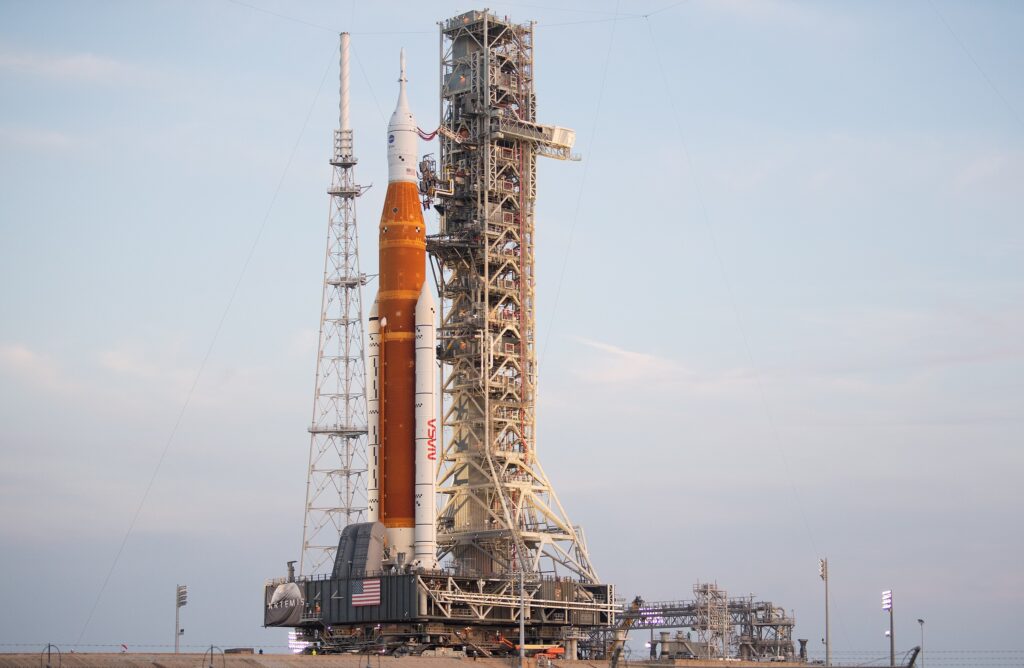
Hanley Changes His Story On Ares 1 Safety - Again

First flights of NASA's Ares rocket: less safe than space shuttle?, Orlando Sentinel

"In an e-mail to the Orlando Sentinel, Jeff Hanley, manager of the Constellation Program that includes Ares I and Orion, said that in the four years since the ESAS was first conducted, there have been advances in engineering risk assessments and that supercomputer analyses say that the ultimate risk of losing a crew aboard Ares I would be just 1-in-2,800. But he acknowledged that even with better risk-assessment techniques and designs, a new rocket poses considerable risk. "What at least some of our work suggests is that, yes, on the second launch the LOC [loss of crew] risk may be roughly on par with today's mature shuttle risk. Other assessments are less rosy (a little riskier than a shuttle launch), so we are working right now to sort out a 'best estimate,'' he wrote."

NASAWatch: NASA withheld safety data from Augustine panel, Orlando Sentinel

"NASAWatch.com, a respected watchdog website, reported on Tuesday night that NASA allegedly withheld information from a White House panel that showed the Ares I rocket did not meet the agency's own safety goals."

Congressional testimony about early Ares flight risks incorrect, Orlando Sentinel

"Fragola said that the passage quoted by the Sentinel story from the Exploration Systems Architecture Study concluding that it would take at least seven flights (two test flights and five mission flights) before the Ares I and Orion crew capsule could to be deemed to be as safe as the shuttle referred to a more powerful configuration of Ares-Orion that used a liquid oxygen-methane engine and not the simpler lower performance configuration being designed today. He said he knew this because he wrote the section  of the ESAS that the Sentinel was referring to. Indeed, the report does say a few pages before the passage quoted by the Sentinel that a LOX-methane engine is riskier than the original simpler design for Ares-Orion, however, Fragola either misremembered the report or was not entirely honest with Congress when he dismissed our reporting."

Keith's note: With regard to Jeff Hanley's current comments, this is not the first time that Hanley's organization has had problems presenting (or admitting) a consistent view of what Ares 1's safety was relative to Shuttle and other launch systems. Indeed, you only have to look at Joseph Fragola's presentation to the Augustine Committee to see what Constellation knew Vs what it said. Specifically, there was a briefing chart that was withheld from the Augustine Committee - see below for that chart.

Both Hanley and Fragola will be testifying. Perhaps someone can ask them about all of this.

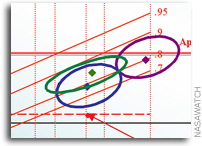
This is the version of the chart (Slide 19) that was used by Joe Fragola in his 29 July 2009 presentation to the Augustine Committee. [click on image for larger version]

This is an internal version of that same chart that was prepared by Fragola's company Valador - but was not used. [click on image for larger version] Note that this unused chart has specific call outs as to Ares I, Ares V/Shuttle, and EELV safety ratings. Note that Ares I does not meet the "Target from Crew Memo" safety goals (red line) that the Constellation program set for itself. Why did Steve Cook not allow this chart to be used?

When asked by Committee member Leroy Chiao to use the chart in his presentation and point out where Ares 1 falls in terms of its relative risk, Fragola used a laser pointer and indicated a region i.e. a safety rating that was above the requirement line i.e. safer than what the internal version of that unused internal chart showed. Chiao's broader question starts at 30:24. His specific Ares 1 question starts at 34:35. The laser pointer is somewhat difficult to make out but a higher quality video will show it much more clearly.

Meeting transcript Page 56-57

Leroy Chiao, Ph.D. In that case, where would Ares fall on this charts?

Joe Fragola - Valador Inc. - Vice President As I recall, it is about 0.85 to 0.86.

Leroy Chiao, Ph.D. Okay, do you have a pointer, can you kind of show us where that might be?

Joe Fragola - Valador Inc. - Vice President It's about... this is 0.8, so 0.85 is approximately around in here. If you talk about a 1 in 200 or 1 in 400 launch vehicle, you are talking about the Ares being up in this area and that is rather significant. If you start looking at the probability that you'll get better than 1 in 1000, no vehicle comes close to Ares l. And, of course, models have uncertainties associated with it. That's why I showed these significantly large bands of uncertainty. But the fact of the matter is it's the combined confidence of high reliability demonstrated on the SRBs for the Shuttle with the understanding of the significant scenarios that create the abort environments that gives you that feeling of confidence on the Ares l.

Leroy Chiao, Ph.D. Okay. And help me a little bit because we've been seeing numbers of Ares being 1 in 2000, but you are saying it might be even be a little less than 1 in 1000.

Joe Fragola - Valador Inc. - Vice President Our calculations are better than 1 in a 1000, better than 1 in a thousand.

Leroy Chiao, Ph.D. Okay then. Maybe I'm confused about what this 1 in 2000 or 2153 number...

Joe Fragola - Valador Inc. - Vice President Well, there are different... this was an independent assessment. There were different models. There were different teams. The teams have not gotten together to resolve the uncertainties but it's important to understand that independent of what the absolute of that number is, the thing to remember is the relative safety level of Ares l is significantly better, to talk about both, significantly better than all the alternatives and significantly better than the current shuttle. Even though the shuttle has demonstrated with a very high level of reliability, it is a question of reliability and abort effectiveness that makes the combination.

Advertise Here

11 Comments

| Leave a comment

So whats the excuse now for not using EELVs to launch Orion - both Delta IV and Atlas V have launched well over 7 times already!!

> In an e-mail to the Orlando Sentinel, Jeff Hanley, manager of the Constellation Program that includes Ares I and Orion, said that in the four years since the ESAS was first conducted, there have been advances in engineering risk assessments and that supercomputer analyses say that the ultimate risk of losing a crew aboard Ares I would be just 1-in-2,800.

Of course, as the Augustine Committee stated, these sorts of probabilistic risk assessments of paper designs only account for an absurdly small fraction of actual launch mishaps, which are in turn only part of the risk of a manned (esp. beyond-LEO) mission.

Do we not know these discussions since more than 30 years? A solid booster will not fail as often as a multipart liquid booster. But if a part of liquid booster fails, it is not necessarily disastrous. Saturn V was the best example. Nevertheless, no rescue system will cover the complete ascent of a vertical launching rocket. If you want a safer launch, you need a horizontal lifting system.

I'm not really sure I see the problem here. Agreed, even the best simulations aren't going to completely eliminate the added risk on the first few launches. That's why any sane launch system (Shuttle, I'm looking at you) is always launched unmanned the first couple of launches. After that, the startup bugs are worked out, the simulations are either validated or adjusted and the error bars are orders of magnitude lower.

I may be wrong but looking at the chart it appears
that Ares 1 OUTPERFORMS EELV significantly.

The safety card has been over played to justify why we are getting rid of the shuttles. The real reason should have been growing costs and age of the system. It was long overdue for an upgrade.

A horizontal launch setup takes a long time to develop.
A more powerful vertical launch saves time, but costs money.
I think what we've been directed towards is the worst of both options. A smaller traditional rocket which, if our goals are truly to go beyond LEO, we will quickly outgrow.

Sorry, but charts like this are smoke and mirrors without having all the basis of analysis to examine that allegedly went into them. For example, the abscissa axis says "failures per launch" but to actually be pertinent to crew safety that must be CRITICAL failures per launch. That takes into account redundancy, fail-operational, and fail-safe design solutions. Assuming that they simply were not being specific and labeled the axis lazily, and that this axis really is critical failures per launch, that would then send one off to examine precisely what failures they deemed critical and how they play into either a Fault Tree Analysis (which I would hazard to guess they may not have yet) or a Failure Modes Effects and Criticality Analysis. This is the massive problem with Powerpoint engineering: It is too easy to mislead by allowing the audience to make assumptions that may not be inherent to your analysis. Finally, a competent system engineer would challenge the "1 in 1000" astronaut office number for validation. How do you KNOW that is a valid number? Where did it come from (other than just a bunch of rocket jockeys sipping coffee and saying it should be ten times safer than shuttle)? Where is a parametric analysis of design features and the hazards they are intended to avoid that will show that 1-in-1000 is actually viable, realizable, and not simply a pie-in-the-sky wish?

I am not impressed, nor convinced by any of this. One needs to be able to "pull the thread" on any of the points on this chart, to follow the entire basis of analysis. That is why model-based SE is so important and powerful: It embeds the analytical basis in a model that can be explored by any and all. One-off charts are for marketing coersion, not demonstrating sufficient engineering rigor.

A risk manager writes...

"there have been advances in engineering risk assessments and that supercomputer analyses say that the ultimate risk of losing a crew aboard Ares I would be just 1-in-2,800."

The result sounds oddly precise. 'Advances in engineering risk assessments' could be big or small and who is meant to be impressed because a supercomputer was involved?

"Other assessments are less rosy (a little riskier than a shuttle launch), so we are working right now to sort out a ‘best estimate'"

Sounds scarily like arbitrage. Got the wrong answer? Just find a different expert.

This risk is not real to him.

Of course I don't know, but I'd be prepared to bet that this is the type of guy who says things like "perception is reality". Challenger and Columbia all over again.

These numbers, which to me are questionable, are for the launch vehicle only. How much added risk is there to the crew because of the corners being cut on Orion because of Ares 1's lack of performance. NASA basically rewrote NPR 8705.2, Human Rating Requirements, to reduce the minimum requirement from two-failure tolerance to single-failure tolerance for critical components. This was done because of weight considerations due to lack of performance. I would not believe these claims of reliability from anyone who would do such a thing. There is no credibility in program management.

I'm not sure if credibility is the appropriate word.

It sort of falls back on Hanley's question of the Augustine committee, 'did they find evidence of mismanagement'. The response being, 'that was not what Augustine was looking for; Augustine was looking to see whether Constellation could be implemented as it was being designed and managed'.

I thought about the word obfuscation. Obfuscation is defined as confused, bewildered, stupefied or perplexed, but I think it usually has connotations of deliberately hiding information.

I think that in the case of Constellation its really just a lack of competence. A bunch of people with no real, substantial experience thrown in to try to lead the future of space flight.

So far their performance; the lack of progress, would say they are having trouble doing the job.

Leadership requires that you know what direction in which to head.


I would have to say if I was on the commission I'd ask how they came to those numbers. Being from near St. Louis, "Show Me". I'd also ask for more than the laser pointer treatment, put the damn thing on the document. I believe you that it's a lot safer, just tell me how you got it. They had to have done quite a lot of analysis to get there and should absolutely have that available for review.

That said, I agree with Patrick. It looks to me like Ares-I outperforms EELV significantly.

Leave a comment


Monthly Archives

Mortgage Lead

online bingo latest online bingo game reviews, bonuses and bingo news

Play online bingo at the top bingo sites.

Interested in Space Travel, try the next best thing, name your own star.

About this Entry

This page contains a single entry by Keith Cowing published on December 2, 2009 2:00 PM.

The Outpost Tavern is Closing - And this time, it is for good. was the previous entry in this blog.

Congressional Hearing on Commercial Space Transportation is the next entry in this blog.

Find recent content on the main index or look in the archives to find all content.


- RADWIN's broadband access enabels cellular carriers to connect users everywhere.

- Looking for great prices on Burton Snowboards? Visit PortersTahoe.com

-