
NASA Will Reveal a "Major Science Finding" About Mars Today
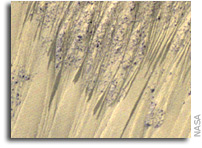
NASA to Announce Mars Mystery Solved
“**Nature Geoscience has Embargoed Details until 8 a.m. PDT/11 a.m. EDT Sept. 28)**
NASA will detail a major science finding from the agency’s ongoing exploration of Mars during a news briefing at 8:30 a.m. PDT (11:30 a.m. EDT) on Monday, Sept. 28 at the James Webb Auditorium at NASA Headquarters in Washington. The event will be broadcast live on NASA Television and the agency’s website.”
 Keith’s 24 Sep note: As is standard practice NASA JPL and researchers have already provided advance information on this news to hand-picked news media – but not to others. But let’s try and figure out what the big ‘ol mystery is. Lujendra Ojha is one of the presenters at the press event and he’s totally into recurring slope lineae on Mars using MRO. Alfred McEwen is a frequent co-author. And they have been trying to figure out how these features form on Mars. One would assume that they have figured that out.
NASA Mars Orbiters See Clues to Possible Water Flows (2014)
“We still don’t have a smoking gun for existence of water in RSL [recurring slope lineae], although we’re not sure how this process would take place without water,” said Lujendra Ojha, a graduate student at the Georgia Institute of Technology, Atlanta, and lead author of two new reports about these flows. He originally discovered them while an undergraduate at the University of Arizona, Tucson, three years ago, in images from the High Resolution Imaging Science Experiment (HiRISE) camera on NASA’s Mars Reconnaissance Orbiter.”
Recurring slope lineae in equatorial regions of Mars, Nature (2013)
“The presence of liquid water is a requirement of habitability on a planet. Possible indicators of liquid surface water on Mars include intermittent flow-like features observed on sloping terrains. These recurring slope lineae are narrow, dark markings on steep slopes that appear and incrementally lengthen during warm seasons on low-albedo surfaces.”
Keith’s 24 Sep update: A NASAWatch reader artfully tipped us off to this session of the European Planetary Science Congress 2015 in France on Monday, 28 September – and one paper authored by several of the participants (McEwen and Ojha) in the NASA press conference:
17:00-17:15 EPSC2015-786 Recurring Slope Lineae on Mars: Atmospheric Origin?, AS McEwen, M Chojnacki, C Dundas, L Ojha, M Masse, E Schaefer, and C Leung
“Recurring Slope Lineae (RSL) are seasonal flows or seeps on warm Martian slopes. Observed gradual or incremental growth, fading, and yearly recurrence can be explained by seasonal seeps of water, which is probably salty. The origin of the water is not understood, but several observations indicate a key role for atmospheric processes. If sufficient deliquescent salts are present at these locations, the water could be entirely of atmospheric origin.”







We can make an even better guess. Press releases like this are often coordinated with conferences. Monday is the first day of the European Planetary Science Conference. Check out the author list and abstract for the talk in the Mars session at 17:00.
Bingo.
Some of them are supposed to be CO2 ice flows no?
That might be their major science announcement? “We’re pretty sure those slope lineae are being created by the atmosphere?” It’d be more fascinating if they proved that subsurface water was flowing on to Mars’ surface.
Oh well. At least it’s not more “we’re found more evidence that water once flowed on Mars”.
I wouldn’t put too much importance on the details of the abstract. They were due in April, and it’s common to submit one while you are still working on the details. Since then, they may have received reached some more exciting conclusons. The abstract is just a strong hint about the topic of the media event.
Actually subsurface water is a known thing. The fact that there is enough moisture in the atmosphere such that it can affect the surface speaks to lots of things of interest including putative biology.
Dry Ice. http://www.space.com/26534-…
This would be very interesting if they can show its actual H2O precipitation that causes the lineae. That is, snow. It is known of course that water vapor can condense on the surface to form ice. But actual snowfall is more controversial.
This would be even more interesting if at low altitudes during daytime hours such snow could reach the ground as rain.
But even if not, the existence of snow, would suggest a hydrological cycle on Mars. Then you could have glaciers forming, melting, and flowing *now* on Mars, not just in the geological past.
Bob Clark
Did
anyone else notice that the one guy said the canadian space agency had
pictures of snow on mars already? Then where was the big announcement
about that. Do the guys in France not know that already happened?
Water/Snow? These scientists and their theories/guesses are just
freakin brilliant….