
Virgin Galactic Reaches "Space"
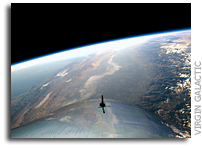
Richard Branson Welcomes Astronauts Home from Virgin Galactic’s Historic First Spaceflight
“The historic achievement has been recognised by the Federal Aviation Administration (FAA) who announced today that early next year they will present pilots Mark “Forger” Stucky and Frederick “CJ” Sturckow with FAA Commercial Astronaut Wings at a ceremony in Washington DC. CJ, as a four-time Space Shuttle pilot, will become the only person to have been awarded NASA and FAA wings.”
 Keith’s note: Virgin Galactic’s SpaceShipTwo reached an altitude of 51.4 miles today after 15 years of struggles to replicate the performance of SpaceShipOne in 2004. AFter some additional tests commercial passengers will reportedly be carried. But did they go to “space” today?
According to Wikipedia “The Kármán line, or Karman line, lies at an altitude of 100 km (62 mi; 330,000 ft) above Earth’s sea level and commonly represents the boundary between Earth’s atmosphere and outer space. This definition is accepted by the Fédération aéronautique internationale (FAI), which is an international standard-setting and record-keeping body for aeronautics and astronautics. … The U.S. Air Force definition of an astronaut is a person who has flown higher than 50 miles (80 kilometres) above mean sea level, approximately the line between the mesosphere and the thermosphere. NASA formerly used the FAI’s 100-kilometer (62 mi) figure, though this was changed in 2005, to eliminate any inconsistency between military personnel and civilians flying in the same vehicle.”
Virgin Galactic’s SpaceShip Two only reached 51.4 miles. So that’s not “space” if you accept the decades-old internationally-accepted definition. Ironically, all of the hoopla and arm waving in 2004 when SpaceShipOne won the XPrize happened only after it had passed the 100km/62 mile Karman line. It took Virgin 15 years to almost make the same altitude again.
But now there’s an effort a foot to lower the internationally-accepted altitude to make it easier to reach “space”. But no one has formally adopted that yet, As such it looks like Virgin Galactic jumped the shark to some extent for the purposes of marketing, etc. In some countries and from the perspective of some regulatory agencies, they did not reach “space” – yet. Just sayin’.






They only went 50 miles. I thought the original version went to the 62 mile limit. I wonder if this iteration will eventually go to the 60 mile mark. If not I would be asking for a refund.
Remains to be seen if VG can operationally tweak the burn and trajectory for a figure closer to the magic 100km mark. This burn was 60 seconds; how long is a full-duration burn supposed to be?
I’ve read they can burn the engine for up to 65 seconds. That would give them some margin. However, what was their flight weight for this mission? If they didn’t include ballast or equipment to make up for the weight of the passengers, then the extra seconds of burn time might just barely be enough to get a loaded vehicle up to the 50 mile mark.
Congratulations! The first Americans to reach space on an American rocket since 2011!
I am wondering why this seems so “ho hum” to me…and similarly why looking at the huge machine I see not what is in front of my eyes but the Spruce Goose, a similar grandeur that suffered from ill-timing.
Not so long ago, the concept of “reaching space” via “hop” seemed like the only immediate way to accomplish the goal. Then the world produced someone with a bigger vision, and the means to accomplish it, obviating these grand devices – and make no mistake, they are the grand product of capable, creative engineers – but these devices will be swept into the incidental hallways of history.
This one of the few times I’ve agreed with you but I do concur.
Maybe you should ride one and get back to us? Seems like a reasonable next step. It seems to me that this would be a crazy wild ride, fire up the engine and pull the throttle back, there’s a certain romance to that.
But in this case we are talking about tourists, from all walks of life and what really matters is what do they think about it, as well as how the general public perceives it. Hard to predict at this point, public interest seems relatively low now, but then again how many years has this been “right around the corner”, so it’s not currently a news story that most people are following at the moment.
But I think once the flights begin there will be a lot of interest, at least that’s my guess. It’s hard to predict the reaction of a population that ranges in space awareness from believing that the Moon landing was a hoax to believing that astronauts have already landed on Mars. But assuming that the flights are successful I think it will enter the public consciousness that ordinary people are now going into space on tourist flights on a regular basis, which personally I think is a milestone in human history even if it’s not a technical milestone. And yes most of those people won’t understand that the tourists are not going into orbit, or even reaching the Karman line in the case of VG, but I don’t think that will be a nuance that most people will be aware of or care about. All they know is that their uncle Ted flew into space and they will think that is incredible and will probably tell everyone that they know about it.
I am hoping that tourist space flights will increase public interest in space travel and perhaps create more public support of the large scale missions that advance us to further goals.
The first celebrities posting their experiences on social media will be a huge turning point, I think, and I’m looking forward to the expansion of the Overview Effect
I’ve already seen scorn being poured on the venture – on Farcebook and YouTube – by whining wussies calling it an ‘immoral waste of money for the one percenters’ and ‘fake news’. Some people need an uppercut, poste-haste…
Though they went into “space” but far from low earth orbit, going LEO like the Shuttle did in 2011 is many order of magnitudes greater. It is impressive but like going to LEO is really not “exploration” considering a rocket has left Earth because it escaped the atmosphere, despite the fact that it is still very much influenced by the Earth.
Back in the X15 days such a flight is very exciting. Fast forward to 2004 when everyone thought there will be a huge market for these suborbital flights but even if that fatality crash didn’t occur I don’t think there would have been a large market anyway (i.e. that Spaceport America isn’t that active and there’s no land rush of people wanting to move there).
Suborbital flights are impressive and I’d love to take a flight on one as well. But for most of the population, we are simply spectators to those that enjoy luxury yachts and private aircraft.
It’s ho-hum because this thing is little more than a reusable suborbital sounding rocket that glides to a landing. I’m sure a lot of people will pay to ride it, but it’s a very short joyride. In the meantime, it’s going to get some business from NASA and others who want to perform (short) micro-gravity experiments.
For suborbital science, it’s better than short periods of microgravity. It’s repeated and frequent opportunities, with the ability to fix or upgrade the experiments. And it’s more than microgravity. It might take some minor modifications for Virgin’s vehicle, but suborbital science also includes UV astronomy (which will be virtually all suborbital work once HST is gone) and studies of the upper atmosphere and lower ionosphere, at altitudes which are inaccessible to orbital spacecraft.
They’ve got to start somewhere. Generating public interest is 80% of the job (one which NASA’s PAO is not very good at). This flight will garner far more interest and press than than something like the Webb Telescope at a fraction of the price. I think they see this as a stepping stone to orbiting a spacecraft. The tech is there, but they need the funding.
I believe people may have said the same thing about a roller coaster.. people will pay money to ride a train car go up and down and return to where they started? That is crazy talk and they will not survive … and a century later?
people are still paying money to go up and down and return to where they started.
They aren’t paying $250,000 per rollercoaster ride, or $27.8 million per hour. If you want people to pay that sort of money, the experience needs to be really exceptional. Either to make it or the bragging rights enough to justify the price. I’m not sure if suborbital tourism can do that. At least not at the price Virgin is charging.
I think that is correct, and presumably prices will eventually come down (even if not VG). However that being said I think there are more people who can afford a $250,000 splurge than we realize. Especially if we consider worldwide. I’d like to see some numbers on common one-day gambling losses as an example. Another example is Concorde, costing $7,000 each way, and yet there were a lot of people who flew it on a regular basis. And from what I have read the idea that these people’s time was so valuable that it made sense was more of a myth. Only one flight per day each direction to each city, from what I recall. And I read an article years ago that said that the on-time departure record was not very good so you lost of lot of that time savings anyway. But no one cared because they liked hanging out in the special Concorde lounge. And anyway the big attraction apparently was being able to casually mention to friends and acquaintances that you just flew in on Concorde.
I don’t think flying on the Concorde was all about bragging rights, but I agree it wasn’t about saving someone’s valuable time either. Lots of people need to get across the Atlantic and really don’t like the prospect of spending nine or so hours in a cramped, uncomfortable seat while breathing reduced pressure and extremely low humidity air. If you could afford it, a supersonic flight which cut the duration in half would be very desirable.
But that’s splurging on making a necessary trip less unpleasant. It isn’t about splurging on an unnecessary trip, because you want to brag about having taken it. People can and have paid for that. But how many, and how much they would pay, is not obvious. I assume companies like Virgin have done studies, but I don’t think many of those studies are publicly available.
I sat in a Concorde seat once (at the Intrepid museum). Pretty small seats, and very little recline. Yes for a shorter flight duration. But one time I flew over seventeen hours (including a stop) in a big cushy seat in business class on a 747 and I was ready to tell them to go around again, I was fine. If I didn’t care about bragging rights I would take first class on a modern 747 or A380 over Concorde (if it was still flying), especially now with the fold flat seats and private partitions. But I don’t disagree that some flew Concorde out of preference for shorter time in the air, even if it didn’t actually help their schedule. But I suspect that the article was right that for a lot of people that wasn’t really it.
” one time I flew over seventeen hours (including a stop) in a big cushy seat in business class on a 747″
Ditto! Delta had a nonstop Mumbai-ATL (or JFK, can’t recall); just over 17 hours and about the most enjoyable jetliner experience I’ve experienced. 777-ER, Business.
Also had occasion once on Virgin Heathrow-MIA in First with full reclining beds. It was a lovely experience – which feels kinda weird to type, actually.
I see your point, but I’d make that first class on a 787, not a 747. The air is the same in first class, and on a 787 or A380, the pressure and humidity are basically the same as Colorado’s urban corridor.
I don’t think the A380 has improved humidity, just higher air pressure, since it’s not all composite like the 787 so they still have to worry about corrosion. However the new A350 reportedly has similar if not better humidity than the 787.
747 and A380 are both on their swan song anyway.
And to a wall street hedgefund manager taking 5 buddies for a flight on this craft will be done in a blink of an eye .. easier than a minimum wage worker wanting to take his family on a roller coaster ride @ 20 bucks a pop…
EVERYTHING is relative .. and 250k is going to be nothing to the people who will be literally lining up to ride on this roller coaster ride..
I am just thankful that the U.S. has enough wealthy people to ride this .. and help lower the costs.. the fuel costs are only about 25k per person is my understanding .. so depending on amortization of hardware costs and life cycle costs.. this price .. under more competition is going to fall ..
I expect a lot of the participants will be from other countries. There are a lot of wealthy people all over the world.
Your $27.8 million dollar figure makes no sense. The cost of around $250K includes takeoff and climb while carried by WhiteKnightTwo then the approximately 10 minute flight. Of that time, 2-3 minutes are weightless. The total time from takeoff to touchdown is around an hour, give or take. There was also talk years ago of having passengers ride in one of the WhiteKnightTwo booms on a training flight before they make their actual flight but I don’t know if they’re still planning to do that.
I think this is a big deal, especially when you consider that the cost for a passenger is likely to be on the order of $250,000 and the passenger flight will go much higher.
I further suspect you won’t find many passengers who, after the flight, won’t be completely chuffed with their experience, and that is the real measure of success.
Virgin Galactic isn’t really making any claims that challenge what companies with orbital spacecraft are doing.
They really need to ramp up the pace if they’re going to have a chance to remain relevant – they have a longer turnaround time, by orders of magnitude, on this suborbital spaceplane than SpaceX has on reusable orbital rockets.
The only logical reason I can think of why they aren’t launching test flights every other week is because they still have major redesigns, not just maintenance and tweaks, to do between flights. If that’s true, they are nowhere near operational status.
I’d agree with the “nowhere near operational” part, but not the bit about major redesigns. Time between flights is an inherent part of flight testing. You need time to look at the results, study them, and decide exactly what the next test should be like. With aircraft, it isn’t a one-off, yes it worked or no it didn’t process. And that’s one of the things which makes aircraft so much more reliable than rockets.
Uh, sounds like the goalposts have been moved. 100 km has always been and ever will be the marker for entry into space from Earth and was the advertisted goal.
According to NASA and the US Air Force, it’s 50 miles.
I wish them well, but for that money I’d want at least 100 kilometers.
That’s what I thought too but some articles I have read says NASA recognizes 50 miles as the limit. But according to this, https://en.wikipedia.org/wi…, it’s the U.S. that recognizes the 50 mile limit.
NASA officially awards astronaut status at 50 miles, not at the Karman line. And, if you go back to von Karman’s original work, he just picked 100 km because it’s a nice, round number. His criteria involved a vehicle’s coefficient of lift, which he just made an educated guess at, and then he just rounded it to 100 km.
Yes, and modern research argues the new boundary should be much lower than the original guess that Dr. von Karman made decades ago.
https://www.livescience.com…
“According to McDowell, that Karman line that many scientists accept today is based on decades of misinterpreted information that doesn’t actually take real orbital data into account.”
“About 50 of these satellites, however, stood out. While re-entering theatmosphere at the end of their missions, each of these satellites successfully completed at least two full rotations around the Earth at altitudes below 62 miles (100 km). The Soviet Elektron-4 satellite, for example, circled the planet 10 times at around 52 miles (85 km) before tumbling into the atmosphere and burning up in 1997.
It seemed clear from these cases that the physics of space still held sway well below the Karman line. When McDowell used a mathematical model to find the exact point at which various satellites finally broke loose of their orbits and made a fiery return to the atmosphere, he found that this could occur anywhere between 41 to 55 miles (66 and 88 km).”
And why a definition based on physics versus a guess is important…
“The airspace above a given country is generally considered part of that country; outer space, on the other hand, is for everyone. If space is defined as beginning at 62 miles and the U.S. flies an unauthorized satellite at 52 miles over China, for example, that could be (justifiably) construed as an act of military aggression.”
The real problem is that all these definitions are vehicle-dependent. They involve things like the coefficient of lift, the ballistic coefficient or something else specific to the hardware. Von Karman made a guess, and McDowell is looking at the statistical average for past spacecraft. But if the technology changes, the basis for the official altitude would become obsolete.
Of course that was true of the old, three mile limit for territorial waters. But that standard has been superseded and the current dispute over the South China Sea makes me think we don’t have any productive precedents.
I agree that the line should not be based on anything vehicle dependent. There is a big difference between the ISS and a cube-sat in terms of the aerodynamic and aero-thermodynamic effect on these vehicles at a given altitude. I therefore propose the line should be based on the atmosphere itself – namely at the altitude where the atmosphere ceases to be “air” in terms of its chemical composition. The effects of photo-dissociation and molecular weight based species diffusion began to have an effect on the mole fractions of the atmospheric species (molecular nitrogen, molecular oxygen, atomic oxygen, argon, helium, and trace species) at 86 km. This is detailed in NASA SP-398, “The 1976 Standard Atmosphere Above 86-km Altitude”. I vote for 86 km.
That’s the homopause, if I understand you correctly. And that’s not a bad choice. But something you said made me think of something else. Let’s stop being so geocentric.
Whatever definition we use for the top of the Earth’s atmosphere should also make sense for the top of another planet’s atmosphere. Where would the Karman line be on Mars or Jupiter? If it isn’t at an altitude a reasonable person would call the “edge of space”, then it probably isn’t the right criterium. The same thing applies to other standards. If it’s a good standard, it should give a sensible value for every planet.
How about the lowest altitude that a sphere with the density of water can complete one circular orbit. I’m not sure if size matters if so then a one meter sphere.
How about splitting the meteorological from aerospace definition.
The former can be based on where the atmosphere stops acting like a gas. Or it can be where the atmosphere becomes undetectable (about 400km). Or whatever suits the science you are doing.
But for objects launched from Earth, only those which reach orbit or beyond orbit are “in space”. Sub-orbital hops are never “in space” regardless of their peak altitude.
I can jump in the air, it doesn’t make me an “aircraft” unless I can stay there. Why should a sub-orbital hopper be considered a “spacecraft”?
I agree that jumping in the air doesn’t make you an aircraft, but even so you were flying through the atmosphere even though you didn’t have the ability to stay there. Well of course you were already in the atmosphere even before you launched but you weren’t flying through it.
If a capsule is launched straight up several thousand kilometers then falls back to Earth, it spends part of that trip flying through space. What if at its apogee it flew in the vicinity of a geosynchronous satellite, at that moment would we say the satellite is in space but the capsule isn’t?
Although I suppose it could be debated whether or not it is a spacecraft since it didn’t remain in space. But as a convention we name things based on their capability. MS-10 didn’t reach orbit, in fact it didn’t even reach the Karman line, but I think most people would still consider it a spacecraft both before and after the flight, since it is clear that the Soyuz capsule was capable of spaceflight. Were Shepard and Grissom’s Mercury capsules not spacecraft but Glenn’s was? Maybe so in one viewpoint but I don’t think most people would think of it that way.
And that’s kind of what it comes down to, how do most people see all of this, since the purely scientific viewpoints are not going to be accepted whether we like it or not. Scientifically speaking the ISS flies in the atmosphere, not in space, as have all so called human spaceflights other than the nine Moon flights. Although if we consider the exosphere as being space then Gemini XI made it that high, albeit briefly, with an apogee for one orbit of 1,300 km.
However I don’t think people will accept this definition of space because they are looking for a relatable definition, not one based on chemistry. Although most people think of the definition of space as black sky, lack of air, lack of sound and weightlessness, none of which make good indicators for determining a boundary, obviously weightlessness isn’t.
So to come up with something relatable but still scientific that leaves either aerodynamics or orbits (or my preference, frictional heating). None of which provides a definite boundary, but at least they can provide an approximate boundary that somewhat matches the observed effects that we see when vehicles travel through, to and from space.
Most people don’t know the difference between a suborbital hop and an orbital launch. Hell, a disturbing number of people don’t know if galactic nebula are closer than the moon. (Seriously.) We don’t create these definitions for the average punter.
As for spacecraft that don’t reach orbit, that situation is the same as aircraft that are on the ground. Ships in dock, boats on a trailer, etc.
While Shepard and the X-plane pilots weren’t flying into “space”, by my definition, we can grandfather in past achievements. Even this VG 50mi hop. The Wright Bros. weren’t qualified pilots by modern standards, but for a moment they were the most experienced pilots in the world. Standards can change.
“Standards can change”
Scientifically ISS flies in the atmosphere and that is not going to change. So the whole discussion about setting lower boundaries for space is bordering on pseudoscience. But to be more charitable, it’s really just a different concept of what defines space. The scientific definition of what constitutes the upper limits of the atmosphere is not rejected, just not considered applicable to the legal, institutional, or cultural definition of space.
“We don’t create these definitions for the average punter.”
Well then for above average punters. As it relates to technical organizations, government, etc. there is a desire to define space in practical terms related to experience and observation. So anyone who will be creating an official, legal etc. definition will be constrained by commonly accepted parameters. For example a definition that puts ISS in the atmosphere and not in space would I’m quite certain be rejected as an international standard. As would setting it at 30 km to placate high-altitude balloon tourism, because most people will reject the idea of a balloon flying in space.
Throwing a dart and going with that is good enough in some people’s opinion, the dart being 100 km which wasn’t even what von Karman advocated. I’m okay with that.
But I’m also okay with modifying the standard to match observed effects. Generally speaking the overall “space experience” isn’t that different for 80 km, 100 km and 110 km, but looking at certain variables a certain way narrows it down for some people into differing opinions. There are so many different ways to look at it I don’t see any way to find agreement. As usual someone in authority will decide, give their rationale, many will disagree but it will become the “law”. Unless it is ignored then the process starts all over again.
“As for spacecraft that don’t reach orbit, that situation is the same as aircraft that are on the ground. Ships in dock, boats on a trailer, etc.”
Right, and we still call them ships and boats. To be accurate they are ships and boats which have not yet been in the water. Prior to flight a capsule is a spacecraft that has not yet flown in space. Of course that’s subjective, I could build something out of popsicle sticks and call it a spacecraft, but obviously no one else will share my opinion so it becomes moot. If however Elon builds something, only the most cynical will refuse to call it a spacecraft until it actually flies in space. And after the test vehicle flies successfully and additional vehicles are built, a cynic would be laughed at if they refused to call each vehicle a spacecraft until each has also flown in space.
My point was, that we can also have things that jump into the air, vehicles that touch the edge of seas, which aren’t aircraft or watercraft. And that, to me, is what suborbital hoppers are. They are not “spacecraft”, whether they reach 100km or 100m.
That’s the “experience and observation”. Hence the aerospace/industrial definition of “space” for objects should exclude such hops.
And IMO, it would give the average person more information in a single word, for eg, when hearing about VG vs actual spacecraft.
I have always thought that the line should be higher, not lower. Of course physically there is no line and it’s all somewhat arbitrary, but von Karman chose to base his calculations on aircraft, i.e. what is the highest that an aircraft can fly in level flight before aerodynamic lift no longer contributes to maintaining altitude without exceeding orbital velocity. But that might as well be describing a flying unicorn as no such vehicle is likely to ever exist that will fly in level flight anywhere near that altitude. X-15 flew at those altitudes but those were parabolic flights.
I prefer a line based on spacecraft, not aircraft, determined by the observed effects that the atmosphere has on space vehicles launching and reentering. For example during launch I notice that payload fairings seem to be jettisoned around 110 km or so. I realize they are giving it some margin due to changing atmospheric densities, but that’s my point, they seem to believe that even at 100 km there can be enough air molecules to affect a payload so they hold onto the fairing for several more seconds at quite a fuel penalty. It seems the standard that everyone follows is to keep molecular heating below 1135 W/m2. That’s equal to 0.100 Btu/(s.ft2) so presumably the original number that they (whoever they are) decided on was the Btu number rounded to 0.1. So yes even this is somewhat arbitrary, but if they have determined through observation and data that they can potentially have payload heating issues up to say 104 km then I say set the line at 105 km. Otherwise it seems odd to say that you can’t safely release a payload fairing even though the vehicle has officially reached space.
Reentry interface also seems to begin a bit above 100 km. Yes the atmospheric effects begin well above that, but there seems to be a point where heating and ionization become quite noticeable and from that point forward a heat shield is required. Again no exact point when that happens and I have not been able to find any consistent data, but I get the feeling that a heatshield is needed quite a bit above 100 km. Whatever the observed maximum is round it up to the next 5 km. Again it seems odd with the current definition that a reentering spacecraft needs a heat shield to protect it from the atmosphere even though they are still officially in space.
I know from past discussion on this that you feel it doesn’t really matter since anything will be arbitrary, and I don’t disagree in principle. I just think it would be more realistic to set a boundary that more closely matches what happens when spacecraft make the transition between the atmosphere and space.
I guess I’d like a definition which doesn’t depend on the nature of the aircraft or spacecraft. I expect those details to change over time. But I haven’t found any definition for space I like. The exobase is nice for science, but many satellite fly below the exposed, so that isn’t practical. I hate to complain when I don’t have a better idea to suggest, but that’s where I am at the moment.
Spacecraft size, shape and mass seem to affect orbital altitude to a greater extent, i.e. what minimum altitude can a spacecraft complete one orbit. I think that probably varies too much depending on the spacecraft which is why I didn’t suggest that as a definition. However I suspect that the friction heating boundary during launch and reentry is more narrow regardless of spacecraft, and maybe capable of being rounded to 5 km with reasonable accuracy. Nothing will be perfect since the line is an abstract concept anyway, but I just prefer something more relatable to actual spaceflight.
Frictional heating is very dependant of the ballistic coefficient (mass to cross section area) and the entry trajectory. That isn’t a spacecraft and mission independent criteria. Nothing is going to be perfect, but I’ve yet to see a standard I’d call good enough. I wish I had or could think of one.
So in the end it seems that there are three viewpoints:
Aerodynamics – at what altitude do aerodynamic forces commonly begin and end.
Friction – at what altitude does molecular heating commonly begin and end for a launching or reentering spacecraft.
Drag – At what altitude can a spacecraft overcome atmospheric drag for at least one orbit.
All three are variable so none will be perfect. But I suspect that if FAI changes things it will be based on the aerodynamic viewpoint since that is the traditional viewpoint, and is also of more interest to suborbital flights, whereas the other two are more related to orbital (or beyond) flights. In reality only people making or providing tourist flights are concerned about the definition of where space begins, so I won’t be surprised if the FAI accommodates them to the extent that they can while still maintaining a rational definition.
Actually, what about free molecular flow? How far does the average gas molecule travel before hitting another molecule? The way a vehicle interacts with the gas changes in fundamental ways when that distance becomes longer than the vehicle.
Makes me think of the “atoms per cubic centimeter” used to quantify interstellar density. Kind of mind bending to really try and imagine but I like that idea of free molecular flow as a boundary.
Sure, but until the FAI is persuaded to change their definition, it seems like bad form to me for VG to claim spaceflight based on a non-canonical definition of “space.”
Workshops on redefining the Karman line in 2019.
https://www.fai.org/news/st…
“Recently published analyses present a compelling scientific case for reduction in this altitude from 100km to 80km.”
Yep, there’s a good chance they’ll be persuaded. But until then, within the context of international norms, VG has reached space*, not space.
It might be bad form, but the FAI and the US government have different standards. That means there isn’t a canonical definition, and Virgin’s statements aren’t fraudulent. That might be an ethically dubious way of using the lack of a canonical standard to generate good publicity. But that is neither illegal nor unusual.
The FAI definition is the one that has been widely agreed upon as having normative value for the purposes of e.g. establishing records and the interpretation of international law. In that sense it is canonical, despite some organizations having their own definitions for their own purposes. You are correct that no laws have been broken, but it is indeed unusual in this context to claim 50 miles as the boundary to space.
It’ll be interesting to see how they certify this “plane” with the FAA, to carry fare-paying passengers.
It won’t be certified as a passenger aircraft, it will be a spacecraft and the rules for them, by law, are different. The standard for a “spaceflight participant,”
http://edocket.access.gpo.g…
2004: Exceeded 62 Miles.
2018: Achieved 51.2 Miles
This is “progress” after 14 years?
2004 was a test vehicle and risky to just the pilots. The 2018 version I would assume has more redundancy and comforts as it will be taking paying guests up. It passed the NASA/military line in the sky, saw the curvature of the earth and experience some microgravity before coming down so I would call it progress and ready to start working through the $13M in deposit they got from 600 folks
To be fair that was SpaceShipOne which would have only carried two passengers and one pilot, the requirement for the X-prize. However Burt Rutan felt that to be profitable they needed to carry five passengers and also they decided to have a co-pilot. Scaling up the design and the hybrid motor was a bigger challenge than they expected.
I can’t argue with any of your points Steve. I guess I’m just coming from a nostalgic place. As a kid the first launches I watched were the Gemini flights and my lifelong space addiction began.
I miss the era where your nation went from a manned Redstone launch in May ’61 to a Saturn 5 launch in Dec. 68. I fully understand that those days will not return. This coupled with Musk’s achievements in this era have just left me a little underwhelmed with this latest flight.
These are simply my personal reflections and in no way I am minimizing the hard work of the men and women who worked to get this far.
I can understand that viewpoint but I see space tourism as separate from the bigger projects, and I fully expect it to always lag behind. Reminds me of the barnstorming days in aviation, most people’s only airplane ride back then was a five minute ride in a WWI era trainer. Actually going somewhere in a “real” airplane was only for military or professional pilots or the very wealthy. But for those people it was a thrilling five minutes. Years later when it was more common for the public to travel by air it was in piston-engine propeller planes, only the military for the most was flying in jets.
As of today only seven tourists have flown in space. I think it’s exciting that soon that number will increase by the hundreds, or even thousands, even if they are essentially just barnstorming flights. And if the prices come down the numbers will increase.
And it looks like tourists will have a choice between an X-15 style flight or an Alan Shepard style flight. I won’t be surprised if some people do both. And it no longer seems that far distant that tourists will be able to duplicate John Glenn’s flight. And as a Gemini era person myself I like to imagine that we will even eventually see tourists duplicating Ed White’s spacewalk. Sure all of that is old hat nowadays but it’s the accessibility that makes it exciting. Maybe not accessible to everyone, but then again most people in the world have still never flown in an airplane, not even for five minutes.
Everyone-
My comment about the event being somewhat ‘ho hum’ wasn’t meant to take away from the enormous success of very talented engineers. It was only to point out that time moves quite fast in this business, and that this little craft likely represents a dead end when the history of access to space is finally assessed.
Indeed it wasn’t humbug that I intended. Only a sort of wistful sadness, really.
The ‘flutter’ technique, though, appears to this non-engineer as a very creative idea.
So… we’re letting the PR department define the boundary of “Space” above the surface of the Earth now?
My thought experiement on the matter: try and place something into orbit at an altitude of 52 miles and see how long it stays there before augering in and burning up.
The layer of atmosphere known as the Thermosphere is reckoned to extend out to roughly 400 KM ( 250 miles ). We already know that on occasion the International Space Station flies thru active but thin auroras at its base altitude of roughly 235 milles / 375km and periodically needs to raise it’s orbit to reduce atmospheric drag. Incoming meteoroids frequently flame out at 125km / 75 m as measured. Virgin Galactic did not even get above the known altitude of noctilucent clouds on its most recent flight. And if anyone cares, climate change is warming the atmosphere causing it to physically expand outwards ( higher) .
Virgin Galactic and the others claiming space is reached at a height 50 miles need to be honest. I’m not buying any of it.
They’re going by the FAA definition, which counts anything above 50 miles as “being in space”. I personally tend to prefer the Karman Line standard, and you make a strong case for an even higher one, but that’s what they went with.
I’ll take the definitives from a modern physical scientist over an anachronist or bureaucrat any day. Plus, the Karman Line is very dated. The guy died in 1963. His theoretical line is where the air becomes too thin to support aerodynamic lift, but nothing in his time flew faster than Mach 2.x. He was still thinking airplanes, not spacecraft.
I’m not sure if I read that correctly. Von Karman was a fine scientist, I wouldn’t call him a bureaucrat and I never heard anything about him being an anarchist. Then again, he was one of the Martians, so who knows…
It would be more accurate to say that their PR department chose one of the two officially recognized boundaries. Since the flight took place in the U.S. it doesn’t seem out of line to use the official U.S. boundary, although I suppose one could argue that since it’s Virgin Galactic they should use the international boundary.
The discrepancy between the two has existed for decades but didn’t seem to cause a problem when astronaut wings were presented to Air Force X-15 pilots who exceeded fifty miles (including Michael Adams, he reached that altitude prior to his fatal crash). Or later in 2005 when it was decided that NASA civilian X-15 pilots who exceeded fifty miles would get astronaut wings (two posthumously). In fact Neil Armstrong attended that ceremony so apparently he didn’t seem to think it was dishonest.
As for orbits, you’re not going to stay in orbit even at 100 km unless it’s the perigee of an elliptical orbit. Interestingly Jonathan McDowell who published his paper last July which seems to have started all of the discussion, advocates 80 km (50 miles) in part because that seems to be the lowest perigee that a spacecraft can make at least one elliptical orbit, based on historical data. And also because it is much closer to what von Karman advocated (not 100 km) even though the international boundary is named after him. The FAI is taking this into consideration, it will be interesting to see what they decide. I also feel that higher than 100 km is more realistic but I tend to doubt that they will raise it.
or use 63,000 feet, the Armstrong Line, where the body needs a spacesuit.
Or a pressurized vehicle, which most people use at much lower altitudes. My body needs about 2 psi of oxygen partial pressure, and that limit is about 11,000 feet. Defining space based on physics is bad enough. I’d rather not add biology to the confusion.
I think they’ve missed their window of opportunity by ten years. Not that I take popularity on social media to be indicative of how worthwhile something is, but barely anyone is talking about this. I see one post on facebook, no comments. This isn’t exciting as actually going to orbit, which SpaceX and I hope Blue Origin can offer in a few years. Virgin should pivot to working on point-to-point travel, as SpaceX is promising with Starship.
“Virgin should pivot to working on point-to-point travel, as SpaceX is promising with Starship.”
They were going to with funding from the Saudis, but that went to hell with the assassination kerfuffle. https://uploads.disquscdn.c…