
“Project Athena” by Jared Isaacman
Keith’s note: A few weeks ago the existence of a “Project Athena” document prepared by NASA Administrator nominee Jared Isaacman and a few close advisors emerged. It had been written during his first nomination period as a shopping list, statement of purpose, first stab at a plan that he was working on for NASA. Then his nomination was pulled. Then it was reinstated. Now it will most likely stick. In the months between this report’s writing and today, much has happened that will nullify, modify, and/or accentuate most aspects of what was written. After its existence became known Isaacman wrote a summary of this summary to clarify a few things. But the actual document remained elusive until it started popping up on various social media accounts on Friday. I have excerpted two main features – the “Workforce Speech – Day 1 Speech”, and “Executive Summary”. You can download the PDF version of the full 62 page document that is circulating here on Google Drive or look at various Twitter and social media accounts for screen grabs and other links. BTW the cover says “Confidential/ Proprietary Information” – well that is moot now – but it was leaked from within a very very very small group of people at NASA who had copies. People leak things for their own purposes. This is a work in progress, subject to wholesale revision and even deletion, so caveat emptor, your mileage may vary, and ad astra y’all. Excerpts below.
IV. ALL HANDS SPEECH
Workforce Speech – Day 1 Speech
I am incredibly grateful to serve under President Donald J. Trump as the 15th Administrator of NASA. I am humbled by the opportunity to work alongside the greatest scientific and engineering minds this nation has to offer.
This is the agency that sent humans to the Moon and brought them home safely, that developed and launched world-changing scientific instruments across the solar system. that pioneered groundbreaking technology, and that showcased American ingenuity with every launch. It is also the agency that has energized a new space industry. restoring our capability to launch American astronauts and opening space to others- something I was fortunate to experience firsthand .
NASA is the most respected space agency in the world-simply seeing the insignia is enough to inspire people to look up and dream of the possibilities. That is what separates NASA from every other government organization – we are leading the greatest adventure in human history-and we are bringing billions of inspired and hopeful people along for the ride.
Like any great organization, NASA is not without challenges. Since 1989, nearly every U.S. president has called for a return to the Moon and a path to Mars. Well over $100 billion has been spent on the grand return and we still face an expensive and lengthy journey ahead.
The problems are not limited to human exploration. There is a history of programs running over budget and behind schedule. When projects are delayed or eventually canceled, it not only wastes resources and opportunities for discovery, but it also leaves NASA’s orbital assets and Earth-based infrastructure even further behind.
I’ve heard the usual explanations- discontinuity between administrations. congressional restrictions. budget challenges, recruitment and retention issues. and more. While there is much for me to learn, from what I can observe:
The agency is spread across many projects, some of which may not be aligned with NASA’s true mission: doing what no other agency or organization in the world can accomplish. There is a top-heavy hierarchy that puts leadership on a pedestal instead of in the trenches, a crushing bureaucracy that paralyzes progress and as a result – I believe a culture has developed that accepts these inadequacies, not out of lack of passion or desire to win. but out of a belief that real change isn’t possible.
I am not here to assign blame as I know everyone who shows up to work at NASA believes in the mission and is equally frustrated when progress stalls. I am also sure many of the present challenges stemmed from historic decisions that were made with the best of intentions. This is not the time to dwell on the past. when I am sure we all want to start looking to the future, but it is important to acknowledge we have problems that necessitate change, or we are never going to get back to achieving what this agency was established to accomplish.
With the support of the President, Congress, and NASA’s leadership, I will be issuing a series of Directives in the coming days. But today, I want to give you a sense of the direction I intend to lead this agency.
We Will Relentlessly Serve Our Mission, by focusing on three challenging objectives:
1 – Lead the World in Human Space Exploration:
Our primary objective-in line with the President’s inaugural address-is for American astronauts to lead in human space exploration. We will work urgently to accelerate the timeline of our immediate lunar ambitions while charting a bold and achievable course to Mars.
We are going to take a hard look at the factors that have historically contributed to delays-both within NASA and among our partners-and ensure that our current path is safe, executable, and positioned for the earliest possible launch opportunities. Even if we have to work around the clock- we will get Artemis II out to the pad and around the moon ahead of the current schedule.
At the same time, we will start preparing for the future beyond Artemis Ill by evaluating our architecture and working closely with commercial partners to determine the safest, most affordable, and sustainable approach for routine deep space missions. As the logical evolution of our ‘big rocket’ efforts, we will dramatically increase investment and urgency around next-generation propulsion-specifically nuclear electric-with the goal in the next few years of having America underway on nuclear power in space.
- In all cases. every program·must have clear objectives that maximize scientific. economic. and national security value for the American people.
2 – Ignite a Thriving Space Economy
After more than a half century. the space economy remains largely unchanged-built around launch capabilities. communications. and observation. with tax-payer funded government spending as the primary customer. NASA will never be able to afford the future we all want to see in space, if the only viable economic model is perpetual government funding. We need to help industry develop capabilities that only the unique environment in space and on the lunar surface afford. that necessitate jobs on and off the planet and ultimately generate value in excess of the initial investment.
- We will prioritize scientific and tech initiatives that have the highest economic potential, working alongside our partners AND finding new partners that are looking to crack the code on the orbital economy.
- The ISS will be the starting point before handing over to what we hope will be multiple LEO destinations, but the future will extend far beyond, as there will inevitably be economic implications from exploring the moon, Mars and other celestial bodies.
- We will future-proof our mission control architecture to support numerous simultaneous operations and prepare for the inevitable flourishing activity that will take place across this great new frontier.
- Over time. NASA should aim to become a partially self-sustaining agency, reducing its reliance on taxpayer funding, much in the way the FAA operates today.
3 – Become a force-multiplier for Science
We will leverage our resources and expertise to enable academic institutions and industry to invest alongside NASA with the aim of increasing the pace of groundbreaking discoveries. We will accelerate scientific breakthroughs and look to prioritize areas that have world changing implications, enable human spaceflight objectives, increase domain awareness in support of planetary defense or could otherwise have economic or national security implications for the American people. NASA has pioneered some of the world’s most exquisite exploration assets-Voyager, Hubble, Chandra, Curiosity, New Horizons, JWST-but we should aim to launch missions like this routinely and affordably.
We will implement a repeatable framework and challenge our historic approach to include more frequent and lower cost missions, making use of commercial services from existing constellation providers and accepting more risk on uncrewed missions to ensure budgets and schedules are maintained.
The agency will leverage its buying power for launch vehicles or bus architectures ;:ind assign our talent to collaborate with commercial partners and academic institutions alongside their $1 trillion in endowments to fund more frequent and ambitious exploration missions.
A Reorganization is Necessary to Meet These Objectives
In addition to the institutional shortcomings. we are in a challenging budget environment and I support the President’s goal to reduce the deficit and restore America’s financial strength. As a nation. we can’t print our way out of this problem-and if you care about the future of science and discovery. then a reorganization is long overdue. I’ve heard from hundreds of passionate scientists. engineers. and astronauts. Many can recite the history behind every agency problem. but most believe real change is unachievable. I disagree. This is a unique moment in history-one where NASA can and must be reorganized to concentrate resources on what truly moves the needle. We will take on this obligation ourselves- because it is the right thing for the future of the agency.
- We will eliminate the bureaucracy and implement a flatter organizational structure that enables clear communication and faster decision-making. That means reducing unnecessary layers of leadership, committees, and review boards that slow progress- and shifting toward fewer managers and more doers.
- We will remove unjustifiable expenses, consolidate departments. and challenge the justification. budget, and timeline of every program that may divert resources from our core mission.
- To be clear. this integrated reorg effort will replace the existing reviews already underway, with the goal of completion before year’s end. I will be transparent. defend our decisions, and get NASA back to exclusively achieving world- changing projects as quickly as possible.
I’ve heard the doubts – that the mission can’t be achieved with less money. I’m not sure when we started believing a million dollars isn’t still a million, or that you can’t do much with billions. At some point, we settled into the idea that everything worth doing must be expensive and take a long time. It doesn’t have to be that way – and it wasn’t in our past. As a nation, we once did bold, ambitious things – quickly and affordably. And I suspect the best and brightest at this agency, and across public service, will soon showcase that ingenuity once again.
You have my commitment to fight for the programs and people that are the backbone of this agency. We will never fly with reduced crews and waste precious opportunities to put explorers in space. And if we are on the verge of something extraordinary-like launching Roman-I will explore every option to get the program to the pad, even funding it myself if that’s what it takes to deliver the science. Alongside the reorganization we will ensure an intense. mission-focused culture centered on:
- A relentless pursuit of the near-impossible for all humankind
- Decision making with a bias toward action and urgency
- Ownership and accountability at all levels
- And A recalibrated risk framework: We will ensure safety is at the forefront of our decision making but the mission of NASA means accepting that some risks are worth taking
I do want to take a minute to expand on what a Mission-driven agency means. I have heard the mantra “if we have 10 Healthy Centers. the science will take care of itself’. When children dream of working at NASA, they don·t dream of healthy centers-they dream of launching rockets. building satellites. walking on the moon and Mars. studying planets and helping unlock the secrets of the universe. That is the mission of NASA and
when we deliver on our objectives, the inspiration, the STEM engagement, the recruiting and the science will all take care of itself.
To succeed, we must hire and promote based on merit and contract with vendors that deliver the best capabilities-on time and on budget. We will align ourselves with international partners not for the sake of having partners, but for those nations looking to meaningfully contribute to our shared mission. We will fund the centers, teams, and capabilities necessary to achieve our objectives as quickly as possible-not for the sake of creating jobs or m;:iintaining facilities. hut for executing urgently on the mission.
NASA is consistently ranked the Best Place to Work in the Federal Government. As an agency with such a challenging mission. NASA should be ranked the hardest place to work in the federal government, the most demanding, the most intense AND the most frustrating when we are not delivering the breakthroughs the world expects from our agency.
If you’re satisfied with your job today-just imagine how you will feel when we return to the Moon, travel under nuclear propulsion, land astronauts on Mars, ignite the true space economy, and deliver the scientific headlines the world is waiting to read.
We Have Competition
We are not the only ones pursuing this mission and these objectives. Our great competitor is making rapid progress-challenging us in human spaceflight, exploration, innovative technology. scientific discovery, and economic opportunities.
If we fail, the consequences go far beyond national pride-they are about breakthroughs that could shift the balance of power here on Earth. President Kennedy stated America will lead in space under a banner of freedom and peace. Our President, Donald J. Trump, just reminded us of that when declaring American Astronauts will plant the ‘Stars & Stripes’ on Mars.
We are in a race-one with strategic implications in the ever-expanding high ground. If we do not lead. we will follow. And if we follow, we may never catch up.
NASA was never meant to be a caretaker of history-it was built to make history. This agency exists to break boundaries, pioneer new technology, take calculated risks, expand the frontier, achieve major discoveries, and inspire the world as to what is possible.
But history isn’t made by protecting the status quo. It is made by those who dare to act-by those who make decisions, move fast, harness the tools and talent this great nation provides, and refuse to accept anything less than success. We are going to make history and I am honored to serve alongside you in the greatest adventure humankind has ever known. Now let’s get back to work.
EXECUTIVE SUMMARY
The following is the draft plan of Administrator-nominee, Jared lsaacman, which aims to transform NASA into a mission-driven agency focused on achieving the near-impossible through a comprehensive reorganization and cultural overhaul. Mr. lsaacman’s strategy emphasizes three core objectives: leading American human space exploration by accelerating lunar missions and advancing Mars exploration through nuclear electric propulsion; igniting the space economy by fostering commercial partnerships and maximizing ISS utilization; and becoming a force multiplier for science.
To execute this vision, Mr. lsaacman outlines his immediate directives, including workforce recognition reforms, organizational streamlining, programmatic reviews. financial and infrastructure audits. and investments in future technologies. Mr. lsaacman also proposes consolidating NASA’s centers for efficiency, modernizing infrastructure, and establishing a “Starfleet Academy” study to develop a regulatory framework for the commercial space industry.
This draft plan, which is subject to refinement based on post-confirmation diligence and workforce input, remains in development and shall not be implemented without consent and approval of President Trump.
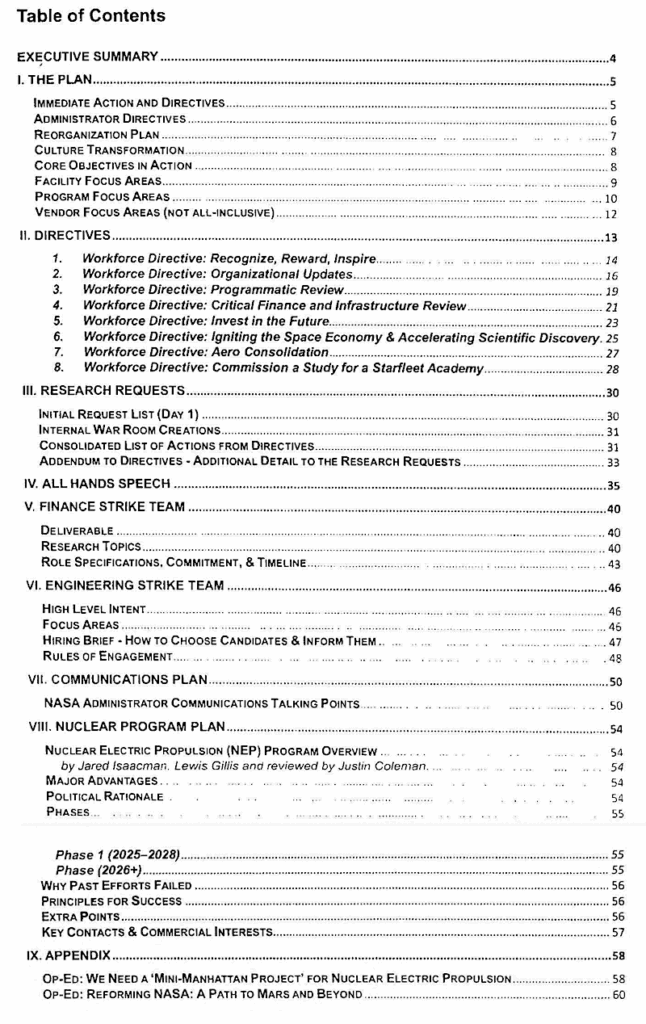
I. THE PLAN
NASA will return to focusing on achieving the near impossible-doing what no other agency, organization, or company is capable of accomplishing. This will require a , reorganization and a reinvigorated culture, all aimed at delivering on the following challenging objectives:
- Lead the world in human space exploration. We will accelerate current lunar ambitions and determine the scientific, economic, and national security value of sustained presence–while in parallel working alongside industry to determine a more affordable, repeatable architecture that applies to the Moon, Mars, and deep space. This includes demonstrating operational nuclear electric propulsion capability.
- Ignite the space economy. To fund the future we all envision in space, NASA must help unlock a broader orbital economy–one that extends beyond launch, observation, and communication–to support commercial activity and generate new sources of value.
- Become a force multiplier for science. We will leverage talent, launch capacity, and standardized commercial bus architectures-working alongside industry and academia to accelerate the pace of scientific discovery.
Immediate Action and Directives
Within the first week, we will:
- Begin hiring temporary and full-time experts, ‘strike teams’, to support the plan.
- Set the stage and expectations with agency leadership alongside space media.
- Communicate the plan agency-wide through an all-hands address alongside Q&A to align the workforce.
- Launch a multi-pronged data-gathering initiative to inform a single, integrated reorganization plan, replacing the fragmented RIF and efficiency strategies currently in circulation.
- Issue a series of Administrator Directives to set the tone to the workforce and put the plan in action. summarized below.
Administrator Directives
Directive #1: Recognize, Reward, Inspire (Day -3) • · Reform the performance system to properly evaluate the workforce – identifying those that should be recognized and those that need improvement or potentially separation from the agency.
- Reinvigorate the recognition system to include flight and payload specialist opportunities.
- Consolidate NASA social media accounts and partner with space media to communicate and document the agency transformation.
Directive #2: Organizational/Productivity Enhancement (Day ~3)
- Request consolidation proposals from executive leadership.
- Flatten the org structure and eliminate deputy/assistant roles and reinstate voluntary retirement.
- End large recurring meetings and other productivity drags unless approved.
- Suspend boards and committees that delay decision making and pivot towards individual ownership and accountability.
Directive #3: Programmatic Review (Day -6)
- Launch deep-dive reviews of the top 10 programs to assess schedule, critical paths, and acceleration levers.
- Initiate a broader phased review of all programs.
- Deploy an engineering strike team to accelerate/fix/delete high priority programs.
Directive #4: Finance and Infrastructure Review (Day -6)
- Stand up a “finance strike team” to perform a bottoms-up independent analysis to inform the broader reorganization effort.
- Conduct a thorough infrastructure review to assess demand and determine opportunities for investment, decommissioning or potentially further monetization.
- Implement commercially–friendly procurement reforms.
Directive #5: Invest in the Future (Day ~9)
- Launch the Mars Program, Project Olympu,. including an expanded nuclear electric propulsion program.
- Begin IT and communication modernization, Al integration, and workforce software alignment.
- Develop the “Mission Control of the Future” initiative to consolidate and upgrade operations including modernization of communication systems.
Directive #6: Ignite the Space Economy and Accelerate Scientific Breakthroughs (Day -9) ” Appoint a Chief Commercial Officer and consolidate the “front door” for external engagement.
- Prioritize and accelerate research throughput on the ISS to include external industry engagement.
- Kick off bulk-buy and science-as-a-service programs to bring down the cost of routine science and energize academic institutions to fund their own flagship missions.
- Reevaluate decadal prioritization process, expand access to existing data, Directive #7: Aeronautics Restructuring (Day 21)
- Consolidate aeronautics related activities under a single Mission Directorate and at a primary operating facility.
- Review all programs for relevancy and focus resources on cutting-edge technology.
Directive #8: Study: Starfleet Academy (~Day 60)
- Begin outlining a regulatory framework for the maturing space industry.
- Develop a training and certification roadmap for spaceflight crew, operators, vehicles, and spacecraft.
Reorganization Plan
We will consolidate all ongoing RIF and reorganization initiatives into a single, comprehensive plan informed by existing efforts, research requests and field teams as indicated in the directives. The goal is completion within 180 days.
Key Inputs:
- Finance Strike Team reports
- AA/Center Director proposals
- AA research deliverables
- Anonymous workforce suggestions
- President’s Budget and OMS deletion guidance
Outputs:
- New org chart aligned to core objectives
- List of deletions
- Before/ After data to justify change
- Ongoing KPI framework to track effectiveness (e.g .. decision velocity. manager-to-doer ratio)
Culture Transformation
We will rebuild a mission-first culture that owns outcomes, acts urgently, and is focused
on achteving the extraordinary. · · ·
- Duty and Competence: Working at NASA is a privilege. To serve in the world’s most accomplished space agency, you need to be dedicated to excellence in
- Mission-Driven Intensity and Urgency: Maintaining a bias toward action and achieving objectives in support of the mission is the highest priority of every NASA employee.
- Ownership and Accountability: We own our responsibilities and the outcomes.
Every project, problem, part, and requirement have a clear owner. - Recalibrated risk framework: We will ensure safety is at the forefront of our
decisions but achieving the mission of NASA means accepting that some risks
are worth taking.
Core Objectives in Action
1 – Lead the World in Human Space Exploration
- Pull forward Artemis II & Ill to the greatest extent possible
- Work alongside industry to establish repeatable and affordable architectures for subsequent lunar and eventually Mars missions.
- Launch Mars program, Project Olympus & Nuclear Electric Propulsion Programs
- Build “Mission Control of the Future”
- Streamline science and research programs to enable human spaceflight objectives alongside national security, scientific, and economic value
2 – Ignite a Thriving Space Economy
- Maximize the remaining life of ISS and unlock the economic potential of LEO to support future LEO destinations.
- Prioritize high potential research and reducing process friction
- Improve ISS utilization. increase crew and research throughput
- Establish new industry/academic incentives (e.g .. 7-seat Dragon. front door. internship tracks)
- Prepare for a future regulatory roadmap for vehicle/crew/operator certification requirements
3 – Become a force-multiplier for Science
- Make flagship missions routine and affordable
- Take advantage of science-as-a-service mode1s where applicable
- Reevaluate Earth science priorities. decadal frameworks, and mission pacing
- Encourage and enable academic institution-funded science and exploration missions.
- Introduce new processes for prioritizing and vetting science proposals
- Investigate ways to alleviate the DSN
Facility Focus Areas
A quick-reference guide to support the reorganization and onsite strike team efforts at
each location.
All Centers:
- Investigate the relevance and ongoing necessity of the center.
- If a requirement, streamline and modernize to make centers more efficient.
- Gather workforce data and trends to measure productivity
- Determine test asset demand, utilization & monetization strategy
Evolve toward financial sustainability (properly monetize revenue centers ).
If you want to read the whole thing you can find a PDF here on Google Drive

3 responses to ““Project Athena” by Jared Isaacman”
Leave a Reply
You must be logged in to post a comment.



Well, he will have to eliminate a tone of NPRs (that would be good). However, I fear that the boss is grossly underestimating the technical and scientific complexity of NASA’s projects. He doe not know what he does not know.
Isaacman’s heart is in the right place and he knows what NASA needs to do. But he will be facing a lot of pushback. None of the centers are ready to give up any responsibilities, jobs or money. And that is not just their managers and employees, it includes their Congressional reps too. MSFC in Alabama has been trying to take over manned spaceflight since von Braun in the 60s and has partially succeeded with ISS, having constructed and tested a module, having set up a mission control operations center. They had the help of JSC in Houston. JSC was taken over by ‘operations’ people who wanted nothing to do with hardware development or mission integration and who actively gave those jobs away to MSFC and KSC. Many of the ‘leaders’ are DEI hires/promotees; no real knowledge or experience. There are similar issues all over NASA-I am just speaking of the areas I’ve seen myself. I got out this year – I did not quite make it to a half century but it was decades since I’d had a ‘real’ job.
And does Isaacman know how many of the doers have already left? NASA is so “failed upwards” heavy of people. I left earlier this year. In the past 3 years we have lost many SME’s and performers who actually cared about the missions due to crap managers. Isaacman should not get advice from any directorate offices or branch chiefs. Most are just protecting themselves while they maintain status quo and squash anyone who speaks up.