
Is Astrobiology As Boring As NASA Thinks It is?
Keith’s 13 May update: someone at NASA fixed the calendar page at astrobiology.nasa.gov. Nothing else was changed. FWIW the NASA search engine still does not know where that website is. Keith’s 10 May note: We’re all concerned about things going offline, cancelled etc. While we only have the “skinny” budget from OMB, it is obvious that big cuts are coming to NASA space science. You’d think that NASA Science Mission Directorate (SMD) disciplines would be standing up to show their stuff – their value – as a hedge against possible cuts. Some are. Others are not. Indeed NASA seems utterly uninterested in telling you that it is spending billions of dollars on Astrobiology research and missions. Next to searching for the origin of the universe, searching for life elsewhere in the cosmos is one of the most profound things NASA does. If only NASA would act that way.
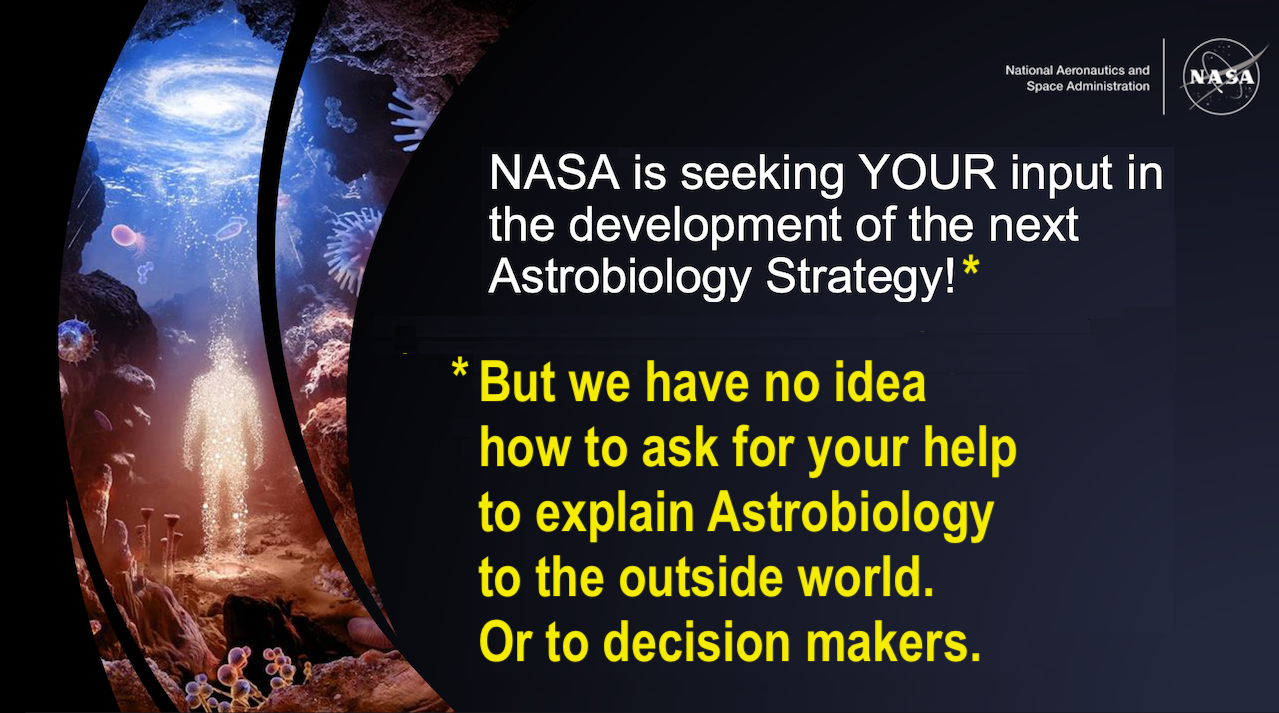
SMD is mounting the NASA Decadal Astrobiology Research and Exploration Strategy (NASA-DARES) effort which it cites as “A new, comprehensive, broad community-sourced Astrobiology Strategy for the next decade and beyond.” Here’s a pretty PowerPoint presentation with an overview. The efforts seem to be a revision of what NASA came up with in 2015. It certainly makes sense to revise things. But no customer is mentioned i.e. who is the audience for this other than everyone. A bunch of National Academy reports are cited, but a specific request for – and delivery point of – contact for NASA-DARES at NASA is not obvious. Is this supposed to affect an SMD program plan? The SMD budget?
Of course, given the pace and broad scope of drastic changes descending upon NASA in the past few months, most of what NASA was planning is now moot. That said, based on the initial lack of a clear purpose for NASA-DARES (other than updating something from 2015), an Astrobiology strategy without a focus or a clear plan for implementation is somewhat pointless.
But wait – suddenly everything NASA does is up for scrutiny. The need to prioritize the value of things is now staring NASA in the face. Some aspects of SMD programs are all over the web and on social media – but Astrobiology is not. And NASA’s official Astrobiology website and other online Astrobiology resources are out of date and barely maintained. Only NASA could make the search of life in the universe boring.
In October 2024 NASA SMD issued the NASA-DARES RFI. They later revised the due date for responses several times (including DEI erasure). There was a webinar in November 2024. They also solicited “Task Force” volunteers to review everything.
But if you go to the NASA Astrobiology website you will see no obvious mention of NASA-DARES. There was mention of a NASA-DARES RFI Findings Workshop on May 29-30, 2025 in an email to a small mailing list. But if you were not on that mailing list then you’ll probably know nothing about this meeting since the NASA Astrobiology website does not mention it.
The “upcoming events” portion of the NASA Astrobiology website mentions “NASA at the American Thoracic Society” 16-22 May (the relevance to Astrobiology is not obvious to me) and also the “NASA PI Launch-pad in-person workshop” from June 2 to September 2, 2025. Wow. that’s a three-month-long workshop. Actually it’s not. It only runs from August 11-14. But again, this calendar is not exactly accurate.
I do my best to highlight this stuff – even if NASA won’t. On my Astrobiology.com website I have made a point of posting all NASA-DARES 2025 updates that I stumble across. I amplify this by posting links on Twitter, BlueSky, Threads, Facebook, LinkedIn. etc. Alas, I can find no mention of NASA-DARES on @NASAAstrobio (819,300 followers), @NASASpaceSci (123,200 followers) or any other SMD social media account.
There is no mention of this Astrobiology workshop or the NASA-DARES RFI at the SMD main website either. In fact the word “astrobiology” does not appear anywhere on the main NASA SMD website – even though there are multiple, overtly astrobiology-themed missions in NASA’s space science flotilla: Two multi-billion dollar rovers on Mars looking for biosignatures, another Mars mission in limbo (Mars Sample Return), Europa Clipper, and another planned for Titan (Dragonfly). And Webb and Hubble and (soon) Roman telescopes et al will also be searching the universe along astrobiology-themed lines.
If you go to NASA.gov and search for “astrobiology” the official NASA Astrobiology website, astrobiology.nasa.gov is not even mentioned on the first page of search results. Or the second, third, fourth pages etc. Instead, the top result is “Are We Alone?“ – a NASA SMD web page that never even mentions the word “astrobiology” – nor does it link to the agency’s main Astrobiology website. Go figure. Why tell anyone about the actual program that does the whole “Are We Alone” thing?
There is a picture of something called the “Astrobiology Federation @NASA HQ” in that pretty PowerPoint presentation. Maybe one of these fine folks can explain why NASA is so shy about talking about Astrobiology. Maybe you can help them.



Leave a Reply
You must be logged in to post a comment.