
Maryland Senator’s Take On Space Budget

Keith’s note: this is an excerpted version of a statement by Sen. Van Hollen (D-MD) on the Senate Passage of Commerce, Justice, Science, & Related Agencies FY 2026 Appropriations Bill – Legislation includes provisions on FBI Headquarters, NASA Goddard, NOAA; rejects Trump Administration cuts to critical programs: Key Bill Points & Highlights: [Note NASA, NSF, NIST, NOAA excerpts] (more below)
“… I also fought to reject the Trump Administration’s attacks on science, including at NASA Goddard, NOAA, and NIST – all based in my home state of Maryland. Our bill makes clear that Congress, on a bipartisan basis, will not accept this Administration’s reckless, harmful cuts.”
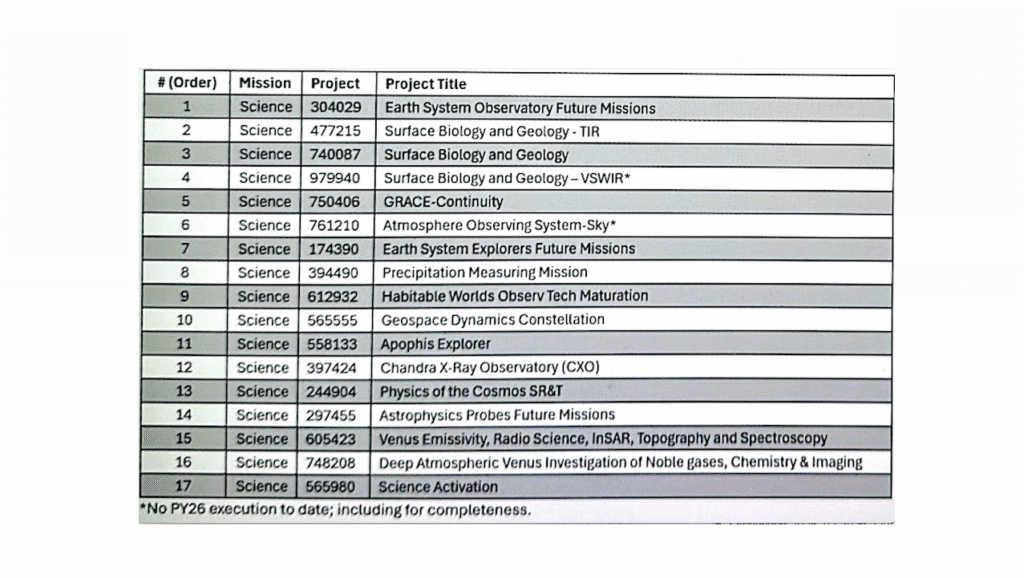
National Aeronautics and Space Administration (NASA): The bill provides $24.44 billion for NASA, which is $5.63 billion above President Trump’s request. The bill rejects the administration’s devastating proposal to cut NASA Science by 47% and terminate 55 operating and planned missions. It instead provides $7.25 billion. The bill provides $1.6 billion for Astrophysics, including $300 million to complete the Nancy Grace Roman Space Telescope to investigate dark energy and the formation of galaxies and stars and $150 million to ramp up development of the Habitable Worlds Observatory that will search for potentially habitable planets, both of which are being developed at the NASA Goddard Space Flight Center in Greenbelt, Maryland. The bill also provides $500 million for the Dragonfly mission to explore Titan, the largest moon of Saturn—led by the Johns Hopkins University Applied Physics Laboratory—and $100 million to ramp up development of the Geospace Dynamics Constellation (GDC) to better understand the Sun’s impact on the Earth—led by Goddard. The bill continues support for a new “Earth Observatory,” which is a collection of five missions to implement the Earth Science Decadal Survey, and the Landsat Next mission to ensure continuity of the longest space-based record of Earth’s land surface. The bill also provides increases for Hubble and James Webb Space Telescope operations and science to ensure full utilization of these incredible assets.
The bill includes critical resources to support the goal of returning Americans to the Moon and of eventually landing on Mars, providing $7.78 billion for Exploration, which is $117 million above fiscal year 2025. The bill supports progress on the Artemis Campaign, including sufficient funding for NASA to meet the ambitious goal of returning humans to the Moon by 2028.
Aeronautics is supported at $935 million, equal to fiscal year 2025 and $326 million above President Trump’s budget request, to ensure continued U.S. leadership in aviation and to invest in sustainable aviation technologies. The bill rejects President Trump’s shortsighted request to eliminate the NASA Science, Technology, Engineering, and Mathematics (STEM) Engagement programs and provides $143 million for the programs. This includes: the Space Grant ($58 million), the Experimental Program to Stimulate Competitive Technology ($26 million), and the Minority University Research and Education Project ($45.5 million).
The bill also includes language regarding recent reports of consolidation at Goddard, noting Congress is concerned about potential negative impacts to operations and capabilities at the Center. The bill directs NASA to preserve all the technical and scientific world-class capabilities at Goddard, including those that will be used to complete any mission funded in fiscal year 2026 by Congress during any campus consolidation. In addition. the bill directs NASA to, no later than 30 days after the enactment of this act, contract a study with the National Academies of Sciences, Engineering. and Medicine regarding the current technical and scientific capabilities housed at Goddard, what capabilities are positioned to ensure long-term success of the NASA mission, including for future cutting-edge scientific discovery and crewed space exploration, and what facilities are needed to house and operate those capabilities.
National Oceanic and Atmospheric Administration (NOAA): The bill provides $6.171 billion for NOAA, $1.67 billion above President Trump’s request. NOAA provides critical weather prediction that people, businesses, and communities rely on each and every day. The bill provides $1.46 billion for the National Weather Service to improve weather prediction capabilities, including a $10 million increase to bolster staffing at Weather Forecast Offices. The bill also provides $1.67 billion to maintain the current generation of NOAA weather and climate satellites and to invest in next-generation satellites—$135 million above President Trump’s request. It also rejects more than $300 million in proposed cuts to the National Marine Fisheries Service, which ensure sustainable management of U.S. fisheries.
Climate Research: The bill supports investments to advance critical climate research. In particular, it provides $224 million for climate research at NOAA, rejecting President Trump’s push to eliminate much of this funding, and it provides $2.15 billion for NASA Earth Science, rejecting President Trump’s proposed 53% budget cut. Funding for NOAA includes $32 million for the National Ocean and Coastal Security Fund, which improves the resilience of coastal communities around the country.
National Institute of Standards and Technology (NIST): The bill rejects the administration’s proposal to slash NIST research and standards work by $150 million and instead invests a total of $1.847 billion for NIST, including $1.25 billion to spur research advances in cutting-edge fields like carbon dioxide removal, artificial intelligence, quantum information science, and cybersecurity. The bill maintains the Senate bill level of $128 million in base construction funding, an increase of $40 million over President Trump’s budget request and the fiscal year 2025 level, to repair and upgrade major NIST research facilities, including facilities at NIST’s main campus in Gaithersburg, Maryland.
Department of Commerce: The bill provides $11.132 billion for the Department of Commerce, $744 million more than fiscal year 2025 and $2.4 billion more than President Trump’s budget request. This includes: $400 million for Economic Development Assistance Programs (EDAP), which is $30 million more than was available in fiscal year 2025, including $41 million for the Regional Technology and Innovation Hub (Tech Hubs) Program—enough for up to two implementation grants for designated Tech Hubs. It also includes $175 million for the National Institute of Standards and Technology (NIST) Manufacturing Extension Partnership (MEP) Program.
National Science Foundation (NSF): NSF is funded at $8.75 billion, rejecting President Trump’s ludicrous proposal to cut federal investment in this essential scientific research and innovation by 57%—which would have returned NSF to its fiscal year 2000 funding level just as our global competitors are doubling down on their investments. The bill invests $7.18 billion for NSF’s research and related activities, level with fiscal year 2025, to help drive U.S. economic competitiveness, including investments in artificial intelligence and quantum information science, and the Directorate for Technology, Innovation, and Partnerships. NSF’s education and training programs to build tomorrow’s innovation workforce are funded at $938 million, rejecting President Trump’s proposal to eliminate these programs. This funding level for NSF should support nearly 10,000 new competitive awards and more than 250,000 scientists, technicians, teachers, and students.



Leave a Reply
You must be logged in to post a comment.