Photos: Fixing Antennas in Space – Today and in a Past Future (Update)


Anchored to a Canadarm2 mobile foot restraint, NASA astronaut Garrett Reisman, STS-132 mission specialist, participates in the mission’s first session of extravehicular activity (EVA) as construction and maintenance continue on the International Space Station. During the seven-hour, 25-minute spacewalk, Reisman and NASA astronaut Steve Bowen (out of frame), mission specialist, loosened bolts holding six replacement batteries, installed a second antenna for high-speed Ku-band transmissions and adding a spare parts platform to Dextre, a two-armed extension for the station’s robotic arm. ISS023-E-047357 (17 May 2010) — high res (0.7 M) low res (55 K)
2021 Update
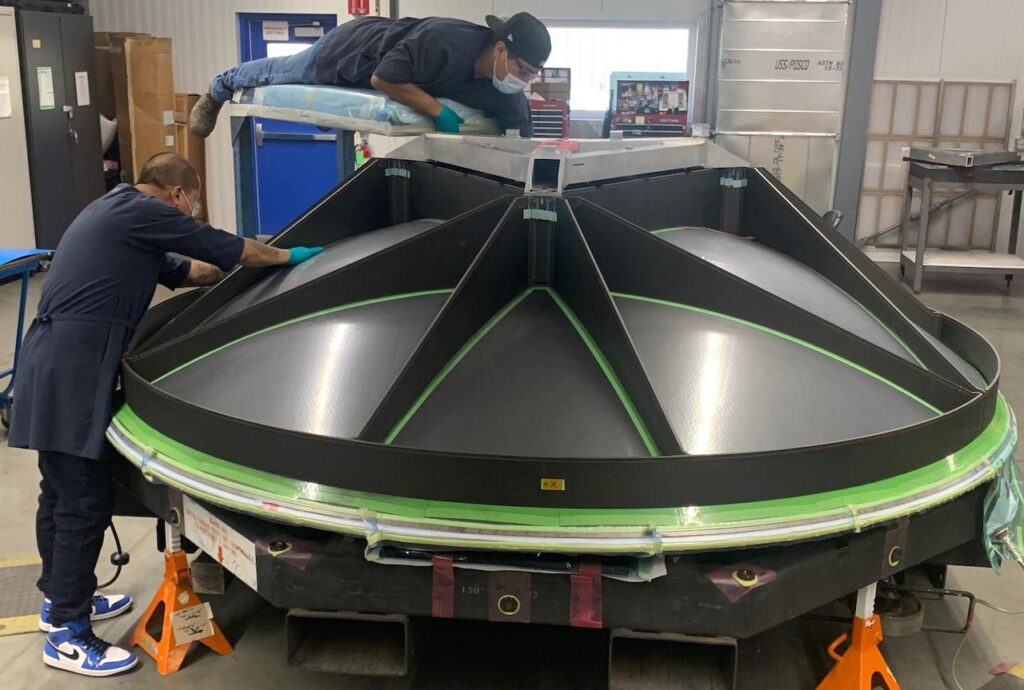
Europa Clipper: High-Gain Antenna Under Construction The build of a high-gain antenna, a nearly 10-foot-wide (3-meter-wide) dish, is underway for NASA’s Europa Clipper spacecraft. The dish antenna, seen here face down, is being fabricated at aerospace vendor Applied Aerospace Structures Corporation (AASC) in Stockton, California. The antenna was designed by the Johns Hopkins Applied Physics Laboratory (APL) in Laurel, Maryland, and AASC, where it will be integrated along with other telecommunications hardware, into the propulsion module. The antenna downloads science data and allows ground controllers to send and receive commands and data between Earth and the spacecraft in Jupiter orbit – more than a million times farther from Earth than the International Space Station orbits.