According to the GAO: “The commercial space industry is rapidly growing as private companies transport cargo, satellites, and people to space. But not all launches go smoothly. Some have exploded or otherwise failed, which can endanger the public. Usually, FAA is responsible for finding out what caused such mishaps. Although FAA can investigate a mishap itself, it has always opted to authorize the launch operator to investigate under agency supervision. But FAA doesn’t have criteria to determine when to authorize an operator to investigate its own mishap, nor has it evaluated how effective its investigation process is. We recommended that FAA address these issues.” Full Report
(more…)Keith’s note: according to a new GAO report “Cybersecurity: Federal Agencies Made Progress, but Need to Fully Implement Incident Response Requirements“: “The Administrator of the National Aeronautics and Space Administration should ensure that the agency fully implements all event logging requirements as directed by OMB guidance. (Recommendation 17)” … “In written comments, reprinted in appendix XI, the National Aeronautics and Space Administration concurred with our recommendation and stated that it plans to address our recommendation by, among other things, creating a comprehensive plan to address all event logging requirements under a recently established Cybersecurity Improvement Portfolio. It also noted certain challenges it faces, such as data integration into the agency’s uniquely designed systems and resource constraints.” [Note: NASA’s response is on pages 63-64]. Previous NASA IT posts
(more…)Keith’s note: According to GAO: The National Aeronautics and Space Administration (NASA) is preparing to land humans on the moon for the first time since 1972 in a mission known as Artemis III. Since GAO’s September 2022 report (GAO-22-105323), NASA and its contractors have made progress, including completing several important milestones, but they still face multiple challenges with development of the human landing system and the space suits. As a result, GAO found that the Artemis III crewed lunar landing is unlikely to occur in 2025. In July 2023, NASA stated that it is reviewing the Human Landing System schedule.
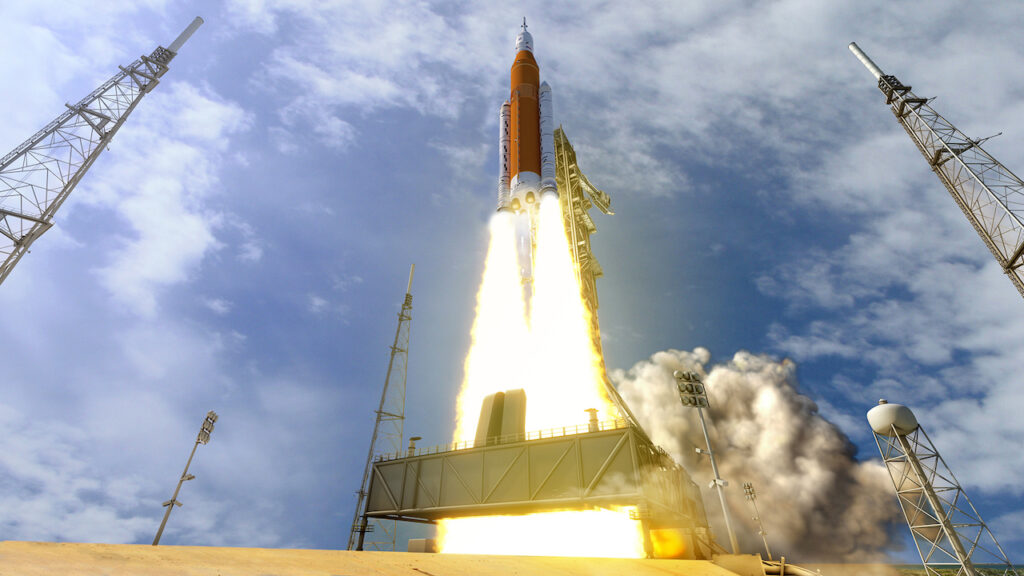
(more…)Keith’s note: According to a GAO report issued today: “Space Launch System: Cost Transparency Needed to Monitor Program Affordability“: “Because the original SLS version’s cost and schedule commitments, or baselines, were tied to the launch of Artemis I, ongoing production and other costs needed to sustain the program going forward are not monitored. Instead, NASA created a rolling 5-year estimate of production and operations costs to ensure that the costs fit within NASA’s overall budget. However, neither the estimate nor the annual budget request track costs by Artemis mission or for recurring production items. As a result, the 5-year estimate and the budget requests are poor measures of cost performance over time. In 2014, GAO recommended that NASA develop a cost baseline that captures production costs for the missions beyond Artemis I that fly SLS Block I. NASA intends to fly SLS Block I for Artemis II, planned for 2024, and Artemis III, planned for 2025. NASA partially concurred, but has not yet implemented this recommendation. A cost baseline would increase the transparency of ongoing costs associated with SLS production and provide necessary insights to monitor program affordability.” Here are More posts in the continuing saga of what SLS actually costs. As if NASA will ever actually know who much these things cost. Why start now?
(more…)GAO Report: Priority Open Recommendations: NASA “What GAO Found In June 2021, GAO identified 11 priority recommendations for the National Aeronautics and Space Administration (NASA). Since then, NASA has implemented four of those recommendations by, among other things, establishing a process for aggregating and assessing cyber risk information from across NASA, and approving an updated cost and schedule baseline for the second test flight of the Orion crew vehicle for […]
GAO Report – NASA Assessments of Major Projects, GAO “Continuing a recent trend, NASA’s portfolio of major projects experienced significant cost and schedule overruns and more projects were added (see figure). Of the 21 major projects in the development phase of NASA’s acquisition process (which includes building and launching the system), 15 were responsible for cumulative cost overruns of about $12 billion and cumulative schedule delays of 28 years. But […]
NASA: Lessons from Ongoing Major Projects Could Improve Future Outcomes, GAO “The complexity of NASA’s major projects means they will always carry inherent risk–but prior GAO work found that management and oversight problems contribute to cost and schedule growth. As NASA works to execute new missions, including those that rely on commercial partners, GAO’s past work provides lessons that, if applied, could strengthen NASA’s management and improve outcomes of its […]
NASA: Lessons from Ongoing Major Projects Can Inform Management of Future Space Telescopes, GAO “The projects in NASA’s current portfolio of major space telescopes–JWST, Roman, and SPHEREx–have roots in past decadal surveys on Astronomy and Astrophysics from the National Academies of Sciences, Engineering, and Medicine. NASA is now considering the results of the National Academies’ 2020 decadal survey, which may spur new projects in this portfolio. NASA has made improvements […]
GAO: Priority Open Recommendations: National Aeronautics and Space Administration, GAO “In April 2020, GAO identified 12 priority recommendations for the National Aeronautics and Space Administration (NASA). Since then, NASA has implemented one of those recommendations when it calculated the Space Launch System program’s developmental cost growth using a baseline adjusted to reflect the scope of work planned for its first mission. GAO also closed two recommendations as not implemented. Since […]
GAO: Weapon Systems Annual Assessment Updated Program Oversight Approach Needed – Excerpt: National Security Space Launch (NSSL) Keith’s note: The ULA Vulcan program has contracted with Blue Origin to provide its BE-4 rocket engine. This BE-4 engine is not referred to by name in this report, but it is what is referred to in this report. “A U.S. produced rocket engine under development for ULA’s Vulcan launch vehicle is experiencing […]