Keith’s note: according to a new NASA OIG report “NASA’s Acquisition of Next-Generation Spacesuit Services“: “NASA faces challenges in ensuring next-generation spacesuits are available to meet the Agency’s current schedules for the Artemis lunar landing mission in 2028 and prior to the ISS’s decommissioning in 2030. NASA’s original schedules to demonstrate the lunar and microgravity spacesuits in 2025 and 2026, respectively, were overly optimistic and ultimately proved unachievable, as evidenced by delays of at least a year and a half for both spacesuits. Based on our analysis, if Axiom experiences design and testing delays in line with the historical average for recent space flight programs, the Artemis and ISS demonstrations may not occur until 2031.” …“if Axiom cannot satisfy its contractual requirements in a timely or cost-effective manner, then NASA could be forced to continue using the problematic EMUs throughout the life of the ISS and significantly adjust its lunar plans.” Keith’s Update: @NASAAdmin Jared Isaacman just posted this response to @NASAOIG: “Very much appreciate the OIG work. As I posted months ago, NASA is not taking a passive role in any component of America’s return to the lunar surface and building a Moon base. We are reviewing where NASA can do better, how we can provide relief where appropriate to burdensome requirements, where we can expand capabilities over time (Apollo 11’s EVA profile was very different than Apollo 17), and where we can help industry by inserting NASA SMEs and driving the intended outcomes. I am confident that when NASA is ready to land on the Moon in 2028, our astronauts will be wearing Axiom suits. There will always be lessons learned as we improve across NASA and industry, and we need to be mindful of the contracting approach to stimulate a market versus jumping to an as-a-service model where NASA may be the only customer for the foreseeable future. That places a significant capital burden on providers while they wait for additional demand to materialize. A successful approach for commercial crew and cargo, underpinned by launch, does not mean it is applicable to every space-related service. The orbital and lunar economy is inevitable. We just need to be thoughtful in our approach to sustainably enable it.”
(more…)Keith’s Note: Last week we all had a moment to savor just how extraordinary the Artemis II mission was – not only for its technological prowess- but more importantly the sense of pride, wonder, and inspiration it generated here and across the world. So, how do we reward the team who did this? We – gut their budget – for the second year in a row -of course. Congratulations! A preview from the LA Times: A renewed threat to JPL as the Trump administration tries again to cut NASA.
(more…)Keith’s note: I was just on BBC World with Astronaut Cady Coleman. We were both asked for a final favorite impression of Artemis II. I said “the crew’s loss for words”. That resonated with me. At one point at Everest Scott Parazynski and I were practicing photo stances for his summit activities with 4 small Apollo 11 moon rocks that Scott eventually took to the summit. I held up the rocks and eclipsed the Moon – with pieces of the Moon – at the foot of Mt. Everest. No one else other than the two of us have ever done that. How do you express that instant of cosmic Zen? I have tried and it’s still incomplete. All these years later I think of that trip every day and feel a responsibility – when I can – to explain the adventure of exploration whenever I can – as incomplete as my words will always be – hopefully so as to inspire others to take up the challenge to explore and convey the value of exploration to an ever-widening audience.
(more…)Keith’s note: The Artemis II astronauts (and their mascot “rise”) will hold a news conference at 2:30 pm EDT today Thursday to discuss their mission around the Moon. Apparently they had no fun whatsoever. You can watch on NASA’s YouTube channel or watch other options. I will be live on BBC World News at between 2:30 – 3:30 PM EDT to provide live commentary on their comments.
Keith’s note: Former Deputy/Acting NASA Administrator Fred Gregory posted this on Facebook and it is reposted here with his permission. “What an accomplishment after such a long multi-generational pause between our moon adventures. Somehow this current excitement must be sustained, motivated not by a competitive adversary but an intense curiosity of what’s out there and why learning and exploring and discovery allows a civilization to survive. After more than 2 years Artemis 2 clearly represents what we can do, but I don’t see or feel the underlying motivation nor excitement to do much more.” More below
(more…)Keith’s note: The exploration of space holds endless resonances with the exploration of Earth:
- On 6 April 1909 Matthew Henson became the first African American to reach the North Pole.
- On 6 April 2026 Victor Glover became the first African American to reach the Moon
Keith’s 11 Nov 2025 note: 75% – 3/4 of the people on this planet have never seen humans walk on another world. We’re suddenly in a race to go back to the Moon and we are not clearly in the lead. The next time humans walk on the Moon will be the first time this happens as far as most of humanity is concerned. History is just history. Instead of grainy, flickering black and white imagery on a hulking television we’ll all see people bouncing on the Moon in 4K streaming on our cellphones. How does NASA adapt to this paradigm shift? So far, it is not doing that well. More below.
(more…)Keith’s note: according to a telecom today all teams polled said GO for Artemis II. They are aiming for a rollout to the launch pad next week on 19 March. A launch attempt is planned as early as 1 April at 6:24 pm EDT . Another opportunity is in place on 2 April and would be at 7:22 pm. There are 4 launch opportunities within the 6 day period in early April. Notes from the media briefing below:
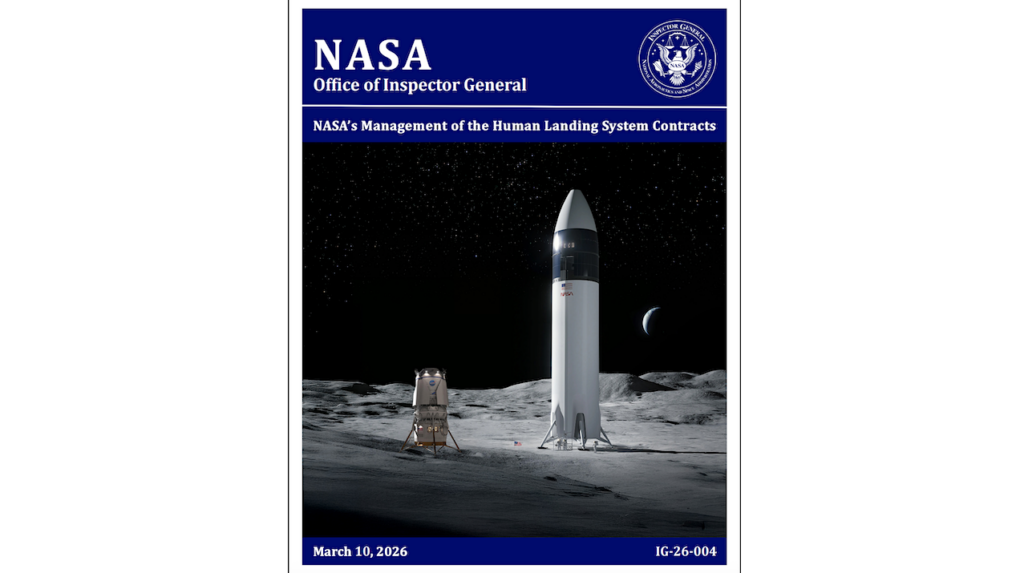
(more…)“NASA’s acquisition approach for the lunar landers has been effective in controlling contract costs, with the SpaceX and Blue Origin contracts having only increased by 6 percent and less than 1 percent, respectively. This was due in part to NASA negotiating mutually beneficial contract changes at no cost to the government. However, both SpaceX and Blue Origin have experienced schedule delays and face technical and integration challenges that have the potential to further impact lander costs and delivery schedules. In particular, SpaceX’s lander will not be ready for a June 2027 lunar landing. To accelerate lander development to meet a 2028 lunar landing date, NASA is assessing proposals from both SpaceX and Blue Origin, but it is too early to determine the technical feasibility, financial implications, and schedule impacts of these proposals.” — “While NASA is taking steps to prevent catastrophic events from occurring, ultimately, should the astronauts encounter a life-threatening emergency in space or on the lunar surface, NASA does not have the capability to rescue the stranded crew“. Full report
(more…)