
Mars InSight Is Having Some Mole Issues

Mars InSight’s Mole Has Partially Backed Out of Its Hole
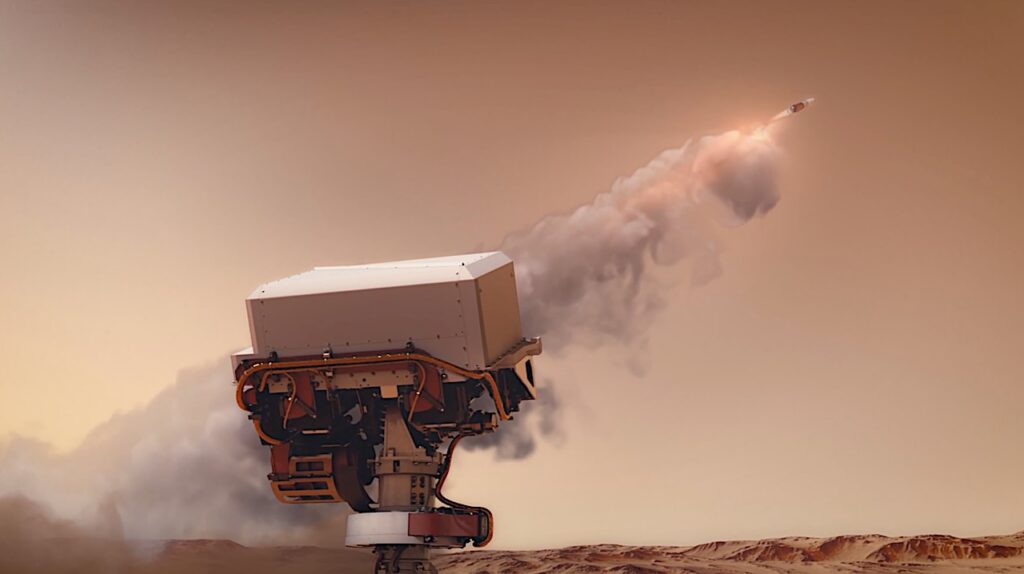
“After making progress over the past several weeks digging into the surface of Mars, InSight’s mole has backed about halfway out of its hole this past weekend. Preliminary assessments point to unusual soil conditions on the Red Planet. The international mission team is developing the next steps to get it buried again. A scoop on the end of the arm has been used in recent weeks to “pin” the mole against the wall of its hole, providing friction it needs to dig. The next step is determining how safe it is to move InSight’s robotic arm away from the mole to better assess the situation. The team continues to look at the data and will formulate a plan in the next few days.”





I am having a little bit of trouble understanding exactly what is going on here. The explanations on Twitter were not clear, either.
Take a look at this:
https://mars.nasa.gov/news/…
Here is a paper describing the mechanism and how it’s supposed to work.
https://www.db-thueringen.d…
It’s true that sending astronauts cost thousands of times more than sending robotic missions. But I have to think an astronaut could dig faster than 1/16th of an inch per day. (Well, under 2 inches per day, if you only count the time the mole was actively trying to dig, and not the months of diagnosing the problem and trying to find solutions.)
Let’s see, astronauts haven’t been beyond LEO in nearly 47 years, while we’ve spent billions upon billions of dollars and seen two terrible tragedies. In that time, robots have explored Mercury, Venus (multiple times), the Moon, Mars (many times), Jupiter (multiple times), Saturn (multiple times), Uranus, Neptune, Pluto, multiple asteroids, and multiple comets. Of greater import, textbooks are filled with the new scientific understandings about our solar system and images that inspire young people and gain admiration for NASA around the world.
The problem to which fcrary is refering isn’t how well robotic probes have done a robot’s job. He’ss lamenting how poorly robot’s do a human’s job.
Watching it dig this hole, I’ve been lamenting the same thing. I’d even elaborate as to how poorly a robot and it’s huge team of human engineers do a GED human”s job.
I feel a “change a light-bulb” joke coming on.
Robotics do great until they don’t. I felt the same way when Spirit got stuck in the sand.
Yep. Dr. Crary’s always been a big fan of robots and he’s right bout this one. But as I pointed out above, is this a case of asking robots to do a job they are Unsuited to do?
What if we send 10 robot probes in sequence, learning from each one and adjusting? I bet they would be digging pretty well by then.
I’m not even sure ten robots in sequence and an evolving design (and operations) would be necessary. They may just have picked a bad spot, and an identical lander in a different location might have had better luck. Or not. But they did land in an “unusual” location. They deliberately selected a site that was nice, flat, rock-free and probably contained few sub-surface rocks. There were good reasons for that, but it does guarantee that is not, in some ways, typical. That could easily mean the properties of the regolith are also atypical. Or not.
You’ve just highlighted the main problem with robotic probes. One of very few problems actually…
Step 1: I have a question.
Step 2: Let’s spend five to ten years building a probe to answer the question.
Step 3: Cool! The probe answered my queation…and don’t get me wrong, I love the answer…but that brings up another question…
Step 4: Rinse, repeat.
You still have to compare the cost. But I would suggest we build and send lots more robots with more capabilities. I mean we could have robots with greater self-control and autonomy than currently. You could even have some human-shaped if you want, just to show that a large portion of that human argument is defeated. I think if you took the money for an initial human Mars landing and spread it around to a bunch of robot teams and launch contracts, we would really be cooking on Mars (Moon, asteroid…) before long. Robotics is getting there and it would be pushed forward. I believe the people, researchers, scientists, engineers would be up for the challenge. Who knows how the math shakes out with how many robots, but for equal cost we could probably send loads of robots with a wide variety of capabilities. Some of them would mine, create materials, and build infrastructure eventually. And this would be a huge benefit to human landing and operations.
I think that sending a robot shaped like a human defeats most of the benefits of both and sticks a huge clown nose on the fact that you’ve just sent a robot to do a human’s job.
I agree about the human shape – and I only threw that part in because of your previous post about Step 1-4… paraphrase: one problem with robots is they can’t follow-up with a new task after a discovery.
Well why not? I disagree there. Consider a continuum of very specific purpose-built robots, all the way to robots that can do anything a human can. Now maybe we can’t get 100% to that side doing everything a human can (yet), but we can get close at least physically… close enough to negate your bit about sending a robot to do a human’s job. What is a human’s job that a robot can’t do? Maybe you could throw out some examples.
I think we could build robots that were nearly as capable as humans in places they are weaker now, and more capable in the many ways that robots can be. I’m just talking in terms of physical movement here. Control, observation, decision making can all be done by humans on Earth still if we want, or robots can operate partly autonomously, or mostly autonomously. For the same cost as sending humans, we could have LOTS of them out there, and they could be getting better and better.
…once humans are on Mars anyway and can thus perform maintenance on such a complex piece of machinery. Then we’ll just build them specialized to do stuff that we can’t do…just like we do here on Earth.
Versatility, thy name is Human. No living creature on Earth even comes close, and every creature on Earth is more autonomous and versatile than current robotic tech. It has a very long way to go. Even Commander Data couldn’t fully replace a human in every way.
Now I get what you said about them doing what they are good at while we do what we are good at, but that involves boots on the ground for both.
That’s not a bad approach. The real problem is that, even for a small, robotic mission, that loop currently takes over ten years per iteration.
InSight (Discovery 12) was proposed in 2010, but people involved in these things typically start serious work on proposals a couple years in advance. The nominal prime mission ends in about a year. That’s not at all atypical.
For the loop you describe (frame a question, build an experiment to answer it, use the answer to frame another question, etc.) to work, I think you need under four years per iteration. In the United States, that’s a typical time for a graduate student to go from qualifying PhD candidacy to defending a thesis. And, at least for some planetary missions, I think four years from formulation to end of mission is possible. It would take some dramatic changes, and a big reduction in cost, but nothing I’d call impossible.
If you look at the successes of robotic missions, they all involve a predictable (or at least a predictably unpredictable) environment. Take New Horizons at Pluto. We knew nothing about the geology of Pluto before the encounter. But we did know that high resolution imaging and near IR spectral mapping would tell us a whole lot about its geology. Similarly, Cassini’s measurements of Titan’s upper atmosphere and ionosphere were quite a surprise. But we knew it had an atmosphere and ionosphere, that we could study it by flying a spacecraft through it, and what sort of instruments we’d want to make those measurements. In contrast, the Voyager Titan encounter was, more-or-less, a bust. No one expected a haze layer so thick and opaque that the Voyager instruments couldn’t see the surface at all.
And, if you look at the successes of human spaceflight, most of them involved improvising to deal with unexpected problems. Especially problems which would have been impossible to predict when the missions were being planned and the hardware was being built.
For the mass it would take to send a human to Mars (food, shielding, return, etc ) couldn’t you easily send a larger more robust machine? After all , on Earth, machines are much better diggers than humans.
There was a workshop in August on subsurface studies of Europa (with the catchy acronym of “Subsurface Needs for Ocean Worlds” or SNOW.) I asked about terrestrial experience with automated drilling, and one of the people there had done deep drilling to subglacial lakes. He said the drilling usually worked best if people just left the equipment alone. Then he qualified that, and emphasized the usually. There are occasional problems and glitches that require human intervention. He said no one had every tried to completely automate this sort of thing.
But I was being a little unfair to the robots. If the mole has only a 10% of succeeding on its own, sending ten, to different locations, would be cheaper than sending astronauts. But NASA isn’t big on the idea of sending ten to make sure one works, and I’m not sure if ten is the right number. We don’t actually know this patch of regolith is “unusual.” I think “very unexpected” is more correct. For all we know, whatever makes it unusual is common on Mars.
Just do your best, JPL guys: we know Mars is difficult. Or harder than expected, anyways…
The mole was built in Germany and I think they are the one working the issue.
The work will be going on all over the place. The HP3 is German, out of DLR, and I think DLR also designed the mole. But the actual construction was subcontracted to a Polish company. They may be involved as well. Then the robotic arm, which is part of the recovery effort, was built by Lockheed Martin outside Denver. And the spacecraft is operated out of JPL. On top of that, the science team includes people who might be the best at guessing what “unusual” soil conditions on Mars might be. They’re all over the place in the US and Europe. Oh, and in the United Kingdom as well.
Amen. Nothing I’ve said is meant as disparagement, just questions. Those guys are a hardy lot and they will figure it out. The scientific results just might be different than expected, which is a lovely thing.
I’m not exactly sure how to interpret this. While everyone knows that there have been Mole issues, these latest tweets are either an attempt to soften the blow when we learn Mr. Mole is Dead; or it’s just a straightforward scientific announcement relating the current state of research.
And while it certainly IS true that Mars is surprising, I guess I thought that the soil characteristics were better characterized by previous missions before sending a mission-defining tool.
Scientists being the cautious creatures that they are, I’m thinking there was no other way to characterize soil Strat before this experiment was designed.
Somehow, it managed to push itself further out, rather than digging deeper. That doesn’t mean the mole is dead, but it’s definitely not a good thing. Some of the confusion may be the way the JPL press release is written. What I saw on their web page earlier today looks like they wrote a couple paragraphs on the current problem, and tacked it on top of last week’s press release (“Progress! Slow progress, but progress. Hooray!”)
Near subsurface properties are very difficult to measure. Telescopes just see the top few wavelengths. You can get a little more by comparing microwave and infrared measurements, or looking at surface temperature changes over the course of a day, but that’s still pretty limited. Other than that, you need to dig. I believe the only excavations I can think of are the trenches from the Viking landers and Phoenix. Those were only a few inches deep and at three locations very far from the InSight landing site.
If you’re havin’ drill problems, I feel sorry for you son.
I got 6.022×10^23 problems, but a mole ain’t one.
OMG you got an audible nerd laugh outta me on that one, Domo arigato Dr. Avogadro 😉
Should have used a drill.