
Imagine A Million People Living On The Moon in 50 Years
 Keith’s note: Jim Bridenstine spoke at a Space Transportation Association luncheon today in Washington DC. At one point he talked about seeing a “million people living on the Moon in 50 years”. So I tweeted that. Soon Twitter lit up with people doing weird math as to how many SLS flights would be required and at what cost. Seriously space fans? SpaceX Starship anyone? Anyway I got a call from Bridenstine a bit later and then tweeted this out:
“OK I just spoke with @JimBridenstine about what he thought he said – and meant to say – but had a slip of the tongue. He meant to say “a million people on the National Mall” celebrating our progress on the Moon 50 years from now. First he referred to huge crowds on the National Mall in DC this past July for Apollo 50 events. He referred to seeing 500,000 people on the Mall here in DC before (we all have) noting “They are usually not happy”. The Apollo crowds were happy. Then he started to talk about how we are going to the Moon to stay, and started to imagine what things would be like 50 years hence such that we could “have a million people on the National Mall” celebrating our exploration and utilization of the Moon.”
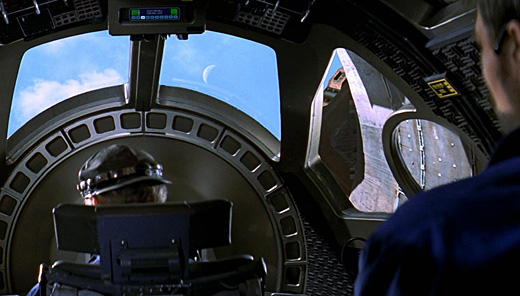
Hmm … maybe Bridenstine was subconsciously channeling “Star Trek First Contact” (even if he claims to be a SpaceBalls/Star Wars fan):
“Zefram Cochrane: You don’t have a moon in the 24th century?
William Riker: Sure we do. Just looks a lot different. There are 50 million people living on the moon in my time. You can see Tycho City, New Berlin… even Lake Armstrong on a day like this.”
One other thing Bridenstine said was “the thing about Apollo is that it ended. We want Artemis to continue”. Imagine If Apollo never ended 50 years ago and that lunar exploration and development continued and expanded. How many people might be living on the Moon now? Its time to catch up.

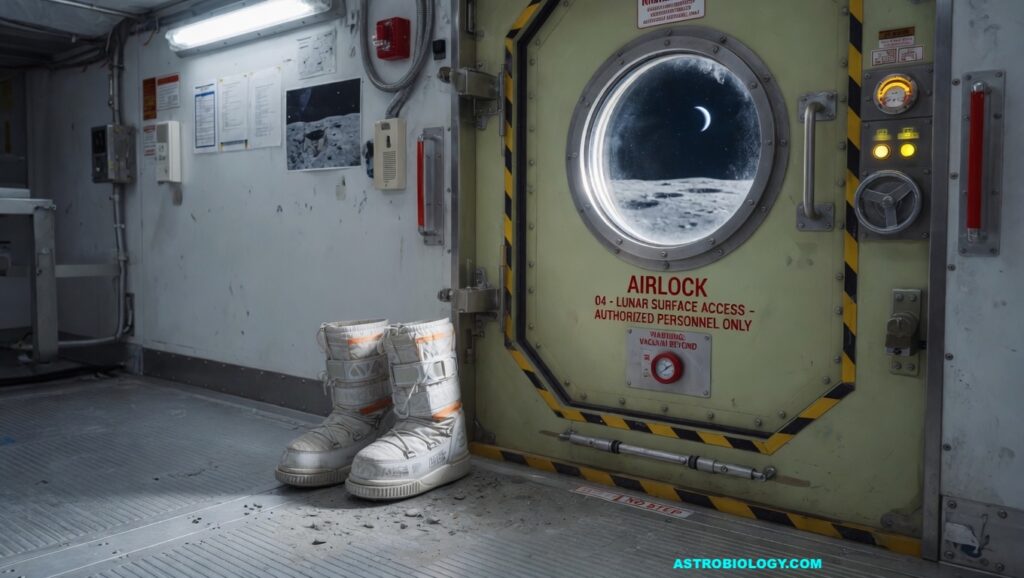
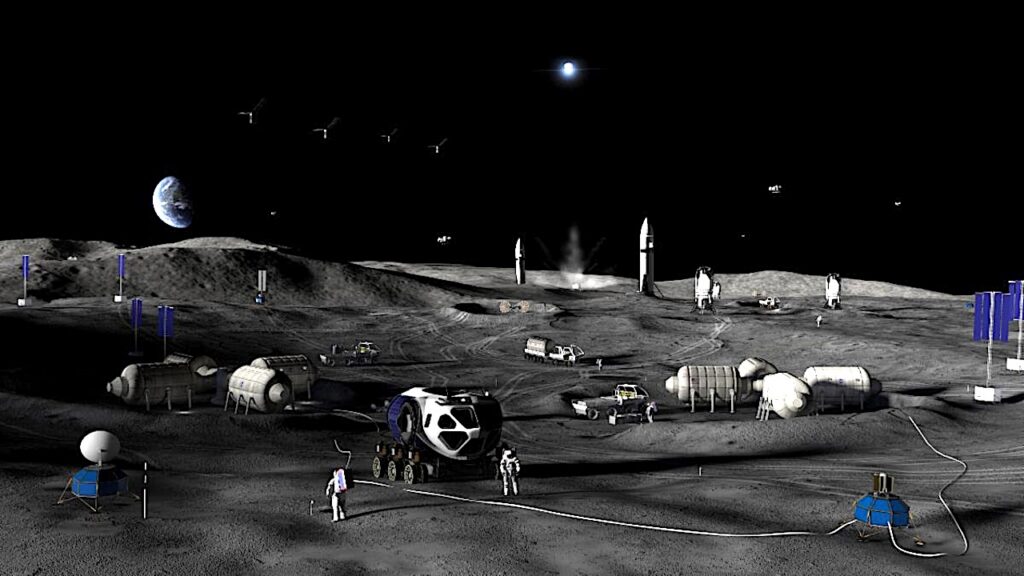


Since lunar industrialization is the key to settlement of the Solar System that would be a good start.?
I can’t get past the fact that Jim Bridenstine called Keith.
I didn’t think NASA even officially recognized the existence of Keith Cowing. 😉
Lots of people call me and I don’t usually talk about it. FWIW Jim talks to everyone.
There isn’t any monolithic NASA view on much of anything, and I’m sure Keith has as many fans as detractors within NASA. But you might also take a look at some of the names who up vote comments to NASA Watch articles. This site’s readership does include some currently and formerly prominent NASA officials.
I think I prefer the vision of a million people living on the Moon in fifty years.
Not gonna happen.
if cost effective.transportation were available, a million people and the infrastructure to support them on the Moon would be very doable. Look at the million a year riding jet airliners to hundreds of enormous sophisticated airports around the world. None of that existed 75 years ago. NASA thinking will not get us there. NASA will be happy if they can send 1 woman. That is why we are hopeful for Elon Musk. He has demonstrated the power of positive thinking.
Actually the number is about 3 million passengers riding the airlines A DAY. And a rocket, besides the propulsion system is not that different from an airliner in terms of the structure and environment.
And just exactly what will all those people be doing there, in confined, low gravity (which we don’t even know the physiological impacts) housing? They wont all be geologists learning about the origins of the universe. Will they all be service industry professionals?And its highly unlikely that any great leaps in the physics of spacecraft propulsion will occur that would enable cost efficient planetary entry allowing anything “potentially” mined from the Moon to be returned to Earth. These are hard facts.
I love science fiction as much as anyone, but when fantasy and pragmatism and reality combine only one or two of them usually win. Exploring this “likelihood” is what needs to be understood and used to really understand and plan the how and why of such endeavors.
They won’t be living in low gravity. I made a presentation at ISDC 2019 in Washington showing how it is easier, and much cheaper, to build 1G habitats on the Moon than in free space. If you develop the capablity to produce structural materials on the Moon like Alumium, Titanium, etc., the cost drops even more. The first sustained off work 1G communities won’t be in open space but on the Moon.
In terms of shipping remember the Earth is at the bottom of a gravity well. Lunar goods won’t be shipped to Earth on spaceships, they will be shipped via railguns and other similar mass driver technology. But major markets are more likely to emerge in serving the space economy.
In terms of the Lunar economy the original drivers will be science, mining, and tourism, but will naturally expand into other goods and services as population increases. New England started out exporting Cod but developed into exporting furs, textiles and shipbuilding. An emigration rate of only 20,000-25,000 a year starting in a decade and including a normal increase from individuals born on the Moon at a rate consistent with industrial societies on Earth could reach a million in that time frame. But even 10,000 individuals calling the Moon home will be a good start to expanding humanity throughout the Solar System.
How do you create a 1G habitat on the moon?
With a centrifuge – if you have need for 1 G.
Yes, basically a tunnel about a kilometer in diameter with modules traveling at the speed needed to produce the .84G difference between lunar gravity and 1G. Side tunnels allowing capsules to speed up to dock with the modules allow the transfer of cargo and individuals. Each ring of modules will house around 1,000 residents.
A similar design will also solve the gravity issue on Mars and other worlds. I call it MAGS for Modular Artifical Gravity System. Best of all the design allows most of technical issues to be worked out on Earth before committing to build the first lunar habitat.
Build it to scale on Earth to 1.05 G first and prove it will run safely and efficiently for 10 years.
Oh, and why go down the path of making something so complicated when we have no clue whether living in 1/6th or 1/3rd G will be harmful to human survival. Sounds like a very expensive project that might be unnecessary.
Sure, got a million or so to donate for it? But actually that is the plan for MAGS, to build it on Earth and work the bugs out first which is the advantage it has over traditional O’Neill type settlements.
And no we don’t know if the human body will adopt and reproduce in 1/6. And reproduce includes the children developing normally into adults. But even if it is possible folks on the Moon will want to travel to Earth and they will be in better shape to do so if the live in 1G on the Moon.
I’m not sure what you’re in favor of. In an earlier comment, you implied that large numbers of people living on the Moon is an unrealistic idea, because we don’t currently know if partial gravity is a safe environment. Now you’re saying that ideas for addressing that potential risk are premature because we don’t know if partial gravity is unsafe. What’s left? Doing nothing but sitting on our hands and doing open ended medical research for decades? It really would be decades, given the nature of the problem.
The speed needed would be 230 km/hr (144 mph.) That’s not impossible but drag would make it a power hog on Earth. On the Moon, you could just leave the tunnels unpressurized.
Yes, well within the ability of a Maglev system. In terms of the lunar tunnels we were looking at them being filled with Nitrogen gas for heat transfer from the modules to surface radiators.
I wouldn’t go with a Maglev. Ordinary rails can handle those speeds, as long as the lines don’t go up and down, and only make gradual turns. I think that matches what you’re describing. There would be no lateral force (the problem with turns) and the cars would be running at a constant gravitational and centrifugal potential, so that’s effectively never going up hill.
Pressurizing with nitrogen would cause gas drag, but that could be minimized. I’d go with cylindrical modules rather than the spherical ones you describe in another comment, some sort of fairing or cover over the passageways between modules, and making the consist as long as possible (minimizing frontal area per unit volume.) Also, nitrogen might be a poor choice. It’s not something you can get in situ, and the tunnels will leak. In general, argon is probably a better pressurant and buffer gas. It’s not exactly common on the Moon, but it is there and much more abundant than nitrogen.
Oh, and you can probably keep the diameter of the modules down to 9 meters, not the 19.5 meters you mentioned. You are, I assume, expecting people to get to the Moon on a vehicle of that diameter. And 30 feet is plenty wide for almost any room people would need.
There is no front because it is not a train in the conventional sense, but a continuous line of modules with no breaks. They are so large because they are designed to have gardens, large open areas, etc., places where it will be possible raise kids, not a simple space station. The diameter of existing or planned spacecraft will not really be a factor since they will be assembled on the Moon from components shipped from Earth. Argon is also an option for cooling, the question is the ease of production on the surface.
I think we should defer to an expert, unless you have consulted one, when it comes to the layout and things like gardens and large, open areas. Someone like Mr. Spencer might have a better idea about the dimensions things like that can fit into, as opposed to the two of us (with backgrounds in things like economics, marketing, physics and engineering.) Personally, I like the idea of long but only 30 feet wide more than 64 feet maximum in all dimensions.
My point about the 9 meter diameter or the SpaceX Starship wasn’t about bringing the hardware for your habitats to the Moon. That would be absurd. But I think you are assuming the people involved would have gotten to the Moon in a vehicle of that size, and found it habitably roomy for something like a week. There is also an implied assumption that the same vehicle would be sufficiently roomy for passenger trips to Mars taking several months. So limiting the shortest dimensions of a room to 30 feet shouldn’t be a problem. It’s something the people involved would be used to after the trip to the colony.
I intially looked at the smaller diameter, but the interior layouts just didn’t seem to work. Also the reason spherical modules rather than cylindrical ones are used is because of better heat transfer. Wheels were considered at first, but then you run into problems caused by friction and worn bearings that would be difficult to fix without consistly stopping and starting the habitat ring.
In terms of dimensions for the modules, that is one of the advantages of the MAGS design. For a modest cost different size modules could be build and tested on Earth to determine what the diameters should be to create a feeling of being open and being livable. This would be done as part of the process of determining how best to place the different systems in them. This is one of the strengths of MAGS, the ability to work out those details, even to the actually assembly process, on Earth long before the first one is built on the Moon and space. And in the process spinoff technologies will be developed with applications to vertical farming, additive manufacturing and facility construction using robotic assistance in remote environments.
I’m not convinced, but that’s fine. I’m sure you know how many ideas for automobiles were floating around in 1890. We’ve got less experience on extraterrestrial colonies than the automotive engineers had back then. For a lunar colony, I think something will work. Maybe as I envision it, maybe as you envision it, or maybe something totally different. The way to find out is to go there and try out all of those different approaches.
Yes, it is time to go and try.
For a million people….hum??
Why not? Not at first of course, but you start with one ring and just keep adding as the population increases. So it may be a million or a lot more. That is how a scalable evolutionary approach works.
Certainly research is needed, chiefly to determine the ‘gravitational flinch points’: what are the upper and lower bounds on human body gravity tolerance? Could we possibly adapt to lunar gravity?
Yes, long overdue.
I think equally important is to find out how much time in an increased gravity environment is needed. Ideally you don’t want to spend your life living in a centrifuge. But what if for example two hours a day of standing, walking or exercising while riding on the “centrifuge train” is sufficient. Then you could spend the rest of the time in 1/6 G in much larger living and work areas.
I’m not sure about that. Living my whole life in a spinning space station or on of Dr. Matula’s lunar habitats on rail track might be ok. But are those ideas practical or necessary? If 23 hours in zero or partial gravity, plus one hour in a one g centrifuge gym, is healthy, then we’ve got a whole lot more options for developing extraterrestrial bases, hamlets, towns or cities.
Yes, but what about travel to and from Earth, especially for those born on the Moon? I know science fiction stories love to talk about their adaption to life in the heavy gravity of Earth, but with a lunar surface MAGS that adapion won’t be needed. Plus given how important excerise is to muscle development I find it hard to see children developing normally on the Moon without it.
However there is alo a back story to MAGS, which is that it was originally developed as a practical method of building large orbital space settlements. The orginal publication of it at the ASCE conferences focused on this aspect of it. But once the mass required for building it was determined it was clear it would be a major barrier to building it if it had to be lifted from Earth. However when looking at the design it was realize that unlike other space habitat designs MAGS would work as well on the surface of a world as it space. This of course opened up whole new potential for it. And by putting the first one on the Moon, made it feasible with developing spacelift technology like the Starship.
I wasn’t implying that your rotating, lunar habitats was a bad idea. It could be a good one. But we don’t know if it’s necessary for permanent residents on the Moon, and we know exactly nothing about how children will develop in partial gravity. Unfortunately that’s a necessary part of growth and exploration. It involves going to new places and environments and learning, by hard and painful experience, what the problems are and how to solve them. Maybe your MAGS concept is a great solution to a serious problem. Maybe it’s solving a minor problem in a difficult way. I don’t think we’ll know until we’ve gone to the Moon in a serious and long-term way.
Yes, time will tell what is needed.
I’m not following, what is it about what I said that you are not sure about?
I’m not sure how bad it would be to live your whole life in a centrifuge. The space habitats imagined by Van Allen and
O’Neill were, essentially, very big centrifuges. Those ideas didn’t strike me as unpleasantly uninhabitable. So I was disagreeing with your statement that nobody would want to live in a centrifuge. If it’s big enough and well-designed, I think many people wouldn’t mind.
I don’t think it’s unrealistic to expect that when building structures on the Moon, that for the same amount of money, construction hours and materials shipped from Earth, that larger, more comfortable and better equipped stationary dwellings and work places can be built compared to dwellings and workplaces that would essentially be part of a moving vehicle. Especially since stationary structures likely can more fully utilize existing building materials including regolith for much of the structure, or whatever metals are easy to obtain. Whereas structures that are built as part of a centrifuge will likely have much tighter design and material constraints, perhaps requiring specific materials that must be shipped from Earth, as well as heavy centrifuge hardware that may have to be fabricated on Earth and shipped to the Moon. And they will almost certainly take much more time to build than stationary structures.
Stationary dwellings and workplaces will also likely be better equipped because of less limitations on weight and space. And it will be easier for people and supplies to move between fixed structures compared to moving between what again are essentially moving vehicles.
On a smaller scale (i.e. gymnasiums) this may not be a problem, but building an entire city on multiple centrifuges on the Moon that people will live their lives in is a bit too futuristic in my opinion, at least within the fifty year time span that is the current discussion. Thus my statement that ideally people won’t have to live their lives in centrifuges but will only have to spend a limited amount of time in them. Of course even better would be if it is found that people can do fine living long term in 1/6 G, in which case all of the structures can be stationary.
That of course is the big gamble, and the conventional thinking, for both the Moon and Mars, that the negative effects of low gravity will be limited and kids will be able to grow up in it. Folks used to make the same assumptions about microgravity as well but we now know it’s not a good long term environment for humans.
But time will tell when humans actually do return to the Moon to do the needed research. Meanwhile, if needed there is a solution, MAGS, which works on the Moon, in open space, on Mars and even the moons of Mars.
“20,000-25,000 a year starting in a decade..”
And exactly what will all those people be doing? Working in the mines? I saw that movie, didn’t end well.
Oh, and exactly how many space ships will be needed to transfer that many people safely and what happens when the first one crashes/explodes/etc. – which will happen.
Oh, and science will NEVER be an economic driver to settle large population of humans anywhere – McMurdo is a perfect example.
Space is in no way an analogue to any other form of terrestrial emigration in human history.
Science will give jobs to the first thousand or so, then tourism will add another few thousand while entrepreneurs drive the cost down through developing new economic activities. ALL frontiers are unique, but all develop into societies via an iterative process that starts when the first settlers call it home. They key is to get the first settlers there to get the process started.
When the Virginia Company was founded they thought the killer app for settlement was Gold and Silver. It turned out to be Tobacco, Cotton and Tar. Colonization never lends itself well to central planning. Instead it’s a messy iterative process, something space advocates tend to ignore.
“Colonization never lends itself well to central planning”
Those politically-driven assertions make me a little itchy! What of the British East India Company?
They did not colonize any frontiers. What they did was to set up trading posts in established ports eventually turning them into colonies by conquest as the opportunities arose. Also their actual management was basically decentralized. Policy was made in the U.K. but it was a long way to the colonies were the actual decisions were implemented.
And, if memory serves, the East India Company was not managed by Her Majesty’s government. The actually British empire didn’t really start until after the Mutiny.
Yes, it was just a joint stock company, privately traded, very similar to a modern corporation but with a lot more power under the royal charter it was granted.
Once again, I bow to the better informed…
The Antarctic Treaty system places serious limits on activities in Antarctica. Commercial resource exploitation is banned, territorial claims are on indefinite hold, etc. In fact, settlement is basically prohibited. If I wanted to put up a hut there and retire, I don’t think I could, regardless of how much money I had. That’s a major reason why McMurdo is no larger than the size required for the scientists and the people supporting them.
If the opportunities were not legally constrained, it’s quite possible other industries would have moved in (adventure tourism, homes for people who like the location and can telecommute, the implies service industry, etc. come to mind.) As a practical matter, any such development would be in the same place as the previously established, scientific stations. That’s just making use of the existing infrastructure. Arguably, the scientific projects would be establishing the initial infrastructure and making things easier for later development.
You really are stuck in the traditional space mindset. They will be moving there for work, because they see more opportunities than on Earth, or just to escape it’s politics. The usual reasons immigrants leave home to start over. As for crashing spaceships, please, planes crash and ships sink all the time but folks keep traveling on them. By the time those numbers are reached space will be no different. We are talking about what will be a social movement, like settlement of the New World or the American West, not a NASA project.
I’m having trouble visualizing these whirling homesteads. What would they look like? And how would lava tubes be utilized?
For the Beta version just imagine a circular subway tunnel 3-4 meters below the surface. The tunnel is 1 kilometer in diameter. The tunnel itself would be 20 meters in diameter and full of spherical modules, each 19.5 meters in diameter, a total of 161 modules. Later versions would use larger modules, especially if the ability is developed to build them on the Moon from local resources.
It will be interesting to see whether living in reduced, but not zero,gravity will cause physiological problems or whether some gravity takes care of such issues. After the radiation problem, this is probably the most significant issue facing future human space flight. NASA could have begun to make serious headway in resolving the issue on ISS. Instead, in NASA’s stupidity they deferred all such research so that it has gotten zero attention. It’s yet another example of how NASA management has gone awry in the last 15 gears. There was a Centrifuge research module not only planned, but built and which now sits as a lawn ornament in Japan becAuse of premature termination of Shuttle. And the scientists who wanted to study the problem remain employed, sitting on their hands with nothing to study. We can talk endlessly about such whirling lunar homesteads but it’s all just meaningless conjecture until we know more.
Yes, I see the failure to do this most basic biological research, while chasing after will o wisps like ET, as one of the biggest disconnects between NASA and serving the real interests of society. Not only would research on the effects of gravity on humans move society closer to space settlement it would, more importantly, provide biological insights which would very likely advance human medicine. It is sad that NASA fails to consider the value to society when it develops its research goals.
I’m afraid NASA considers how exciting its research goals will sound to the public and Congress. Finding ET gets higher points for excitement than finding out if your grandchildren could be born on the Moon without medical complications. That’s not exactly NASA’s fault; they’re matching their goals with what the customers want.
Partial gravity and radiation are issues, but I don’t see them as obstacles. They are if you want to go from the current state of the art directly to a major colony in space. But that’s not realistic. Right now, we do have bad but viable solutions to those problems.
I think it’s safe to assume that partial gravity isn’t _worse_ than zero gravity. And we know that’s not a major health risk for missions lasting a year. So, with no further research on the subject, we can plan on bases where astronauts spend up to a year on the Moon. Which gives us the data to say whether longer stays or not a problem, or what countermeasures are needed if there is a problem.
The same is true of radiation. Piling rocks on top of a habitat and astronauts spending most of their time inside may be esthetically poor and it would be a pain operationally. But it would mitigate the radiation issues. And, most likely, the risk is only at the level of a few percent extra risk of cancer later in life. Many people would call that an acceptable risk. And, after looking over the odds of the risks being higher, many people would still call it an acceptable risk.
That means we can actually learn how to deal with partial gravity and radiation while actually doing something beyond medical research. The problem with that sort of research is that the risks are low over short periods and (in the case of radiation) it’s a low dose rate over a long time. If you want to do animal experiments to verify (or refute) the linear, no threshold model of radiation hazards, you might need to expose thousands of lab rats to a weak radiation source, and do so for years or decades. That’s expensive and bad on the careers of researchers who need to publish results to get tenure. That’s why so much work focuses on high dose rates over short periods, and guessing about how to extrapolate to more realistic situations.
Welcome Homo Sapien Lunamaccommodari!
New cities, or towns, is a subject much loved by geographers, landscape architects, planners, and civil engineers. As we have learned over the past 75+ year, though, the creation of new cities, while affording residents untold efficiencies, has been an uphill battle at best (Brasilia being an example).
In the broader sweep of time, villages appeared soon after we learned the benefit of agriculture, giving up hunter/gatherer life. These aggregations tended to focus on rivers, which facilitated trade; and trade grew, too, facilitated by transportation. Specialists soon appeared, and we were off.
While that’s an over-broad description, generally population aggregation followed agriculture and the need for protection from invaders.
How do we apply these principles to lunar settlements? Look for concentrations around resources, like energy, or ores. Maybe the moon’s varying density is high enough to encourage rocket transportation?
Those are a whole lot of good questions, and I don’t know the answers. But the first thing which comes to mind is infrastructure. A settlement on the Moon, or anywhere in space, will be critically dependent on civic infrastructure. That’s rare to unprecedented in the Earth’s history, at least for places which eventually grew into major cities. I’m having trouble thinking of any. Dubai? But it was marginally habitable from the start. I know line about God making the world but the Dutch making Holland. And Holland is critically dependent on civic infrastructure. But that’s not quite the same as the situation on the Moon. I’m not sure if there is any historical guide or precedent for the sort of thing we’re talking about.
Realistically, a million people in fifty years isn’t even something the SpaceX Starship could do. At 100 people per flight, that’s still 200 flights per year, starting tomorrow. Even if they build enough vehicles to make the turn-around time realistic, we don’t have the pads, flight control infrastructure (and it would be flight control, not mission control, at that point) or even the deep space telecommunications assets.
My personal prediction is that a million people on the Moon in fifty years is possible, but not with anything we have on the drawing boards today. That would be like expecting the aircraft of 1920 to support the airline traffic of 1970. It’s possible the lunar transport vehicles of 2069 will be called a “SpaceX Starship”, but it’s probably going to be a Mk 20 or so, and will bear little resemblance to the Mk 3.
Don’t forget about folks having kids. You could have a lot of kids in 50 years… Also 100 is the limit of SpaceX for expeditions to the Moon. As a one way transport it could probably be configured to carry a lot more emigrates to the lunar settlements.
Hilarious mistake.